
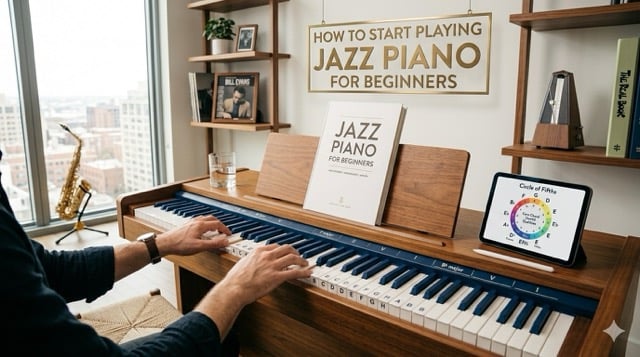

Are you a piano learner who's always admired the smooth, sophisticated sounds of jazz but felt intimidated by where to begin? You're not alone! Jazz piano can seem like a complex world of scales, chords, and improvisation, but every journey starts with a single step. As your friendly piano teacher, I'm here to guide you through those first exciting steps, focusing on practical playing rather than abstract theory. Let's unlock the magic of jazz together!
What Makes Jazz Piano Unique?
At its heart, jazz is about expression, rhythm, and harmony. Unlike classical music, which often focuses on interpreting existing compositions, jazz thrives on improvisation – making music up on the spot – and a distinctive "swing" feel. It's a conversation between musicians, full of surprises and creativity. But before you improvise like a pro, we need to build a solid foundation.
Step 1: Immerse Yourself – Listen Actively!
Before you even touch the keys, the most important step is to listen. Jazz is an aural tradition. Spend time listening to different jazz pianists and styles. This isn't just background noise; it's your essential learning material.
Who to listen to: Start with accessible legends like Oscar Peterson, Bill Evans, Dave Brubeck, or even modern players like Robert Glasper. Listen to how they phrase melodies, how their chords sound, and especially their rhythm.
What to listen for: Pay attention to the overall feel, the "swing." Can you hear how the rhythm section (bass and drums) grooves? How does the piano interact with them?
Practical Exercise: Pick one jazz standard (like "Autumn Leaves" or "Blue Bossa") and listen to at least three different versions by different pianists. Notice the differences and similarities.
Step 2: Understand Basic Jazz Chords – The Seventh Chord
In classical music, you're used to triads (three-note chords). In jazz, the dominant chord type is the seventh chord. This simply means we add one more note to a triad, making it four notes. These added notes give jazz its characteristic rich and often melancholic sound.
Major 7th Chord (Maj7): Root, Major 3rd, Perfect 5th, Major 7th. (e.g., Cmaj7: C-E-G-B)
Dominant 7th Chord (7): Root, Major 3rd, Perfect 5th, Minor 7th. (e.g., C7: C-E-G-Bb) – This one is crucial for blues and resolving harmonies!
Minor 7th Chord (m7): Root, Minor 3rd, Perfect 5th, Minor 7th. (e.g., Cm7: C-Eb-G-Bb)
Practical Exercise: Find all three types of seventh chords starting on C (Cmaj7, C7, Cm7). Play them in root position. Then, try playing them as two-hand "shell voicings" – left hand plays root and 7th (or 3rd and 7th), right hand plays 3rd and 5th (or just root, 3rd, 5th, 7th). Focus on clarity.
Common Mistake: Many beginners try to learn all the complex jazz chord voicings right away. Start with basic root position and simple shell voicings. Focus on the sound and function before getting too fancy.
Step 3: Get Your Rhythm Right – The "Swing" Feel
Jazz isn't just about the notes; it's about how you play them. The "swing" feel is what makes jazz groove. Instead of playing all eighth notes evenly, we play them with a long-short feel, often described as triplets with the middle note removed. Think "DAH-da DAH-da" instead of "DA-da DA-da."
Practical Exercise: Set your metronome to a comfortable tempo. First, play a C major scale, playing all eighth notes straight. Then, try to "swing" those eighth notes. It feels like the first eighth note of the pair is held longer, and the second is shorter and pushed towards the next beat. You can also use a metronome app that has a swing setting to hear and feel it more easily.
Step 4: Learn a Simple Jazz Standard – Melody and Chords
Now that you have some basic chords and a sense of rhythm, it's time to put it together with a song. Learning a jazz standard is like learning a pop song – you learn the melody and the chords.
Choose your first standard: "Autumn Leaves," "Blue Bossa," or "Fly Me to the Moon" are excellent choices for beginners.
Find a lead sheet: This is a piece of sheet music with the melody written out and chord symbols above it.
Steps:
Learn the melody: Play it accurately with your right hand.
Add basic chords: In your left hand, play the root or simple two-note shell voicings of the indicated chords as you play the melody with your right hand. Don't worry about complex voicings yet.
Combine and feel the groove: Play through the tune, trying to apply that swing feel.
Concrete Practice Tip: Break the standard into small, manageable sections (e.g., 4-8 bars). Master each section before stringing them together. Don't try to play the whole tune perfectly right away. Slow practice is your best friend!
Step 5: Your First Steps into Improvisation – The Minor Pentatonic Scale
Improvisation is at the heart of jazz. For your very first steps, don't overthink it. A great starting point is the minor pentatonic scale.
What it is: A five-note scale (Root, m3, P4, P5, m7). For C minor pentatonic: C-Eb-F-G-Bb.
How to use it: Play a simple blues progression in C minor (Cm7 - F7 - Cm7 - G7). With your left hand, play the root or simple chords for each measure. With your right hand, experiment playing notes from the C minor pentatonic scale. It will sound good over all these chords!
Focus on: Playing melodically, using space, and listening to how your notes sound over the chords. Don't worry about being brilliant; just explore!
Keep Going and Enjoy the Journey!
Starting jazz piano is a marathon, not a sprint. Be patient with yourself, celebrate small victories, and most importantly, keep listening and experimenting. The more you play, the more you'll understand, and the more you'll fall in love with this incredible genre. Happy swinging!