The Major ii–V–I
Updated: 2026-07-06If you learn one thing in jazz, learn the ii–V–I. It's the home cadence of the music — the three-chord cell that appears, in some form, in almost every standard. Master it in all keys and you can navigate most of the repertoire.
Key takeaways
- The ii–V–I is jazz's home cadence: predominant (ii) → dominant (V) → tonic (I).
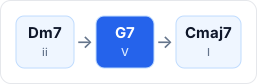
- In C major it is Dm7 → G7 → Cmaj7.
- It appears constantly because the roots move down in fourths — the strongest harmonic motion.
- Practice it in all 12 keys around the circle of fourths.
This builds on Roman Numerals & Cadences and Harmonic Progression & Function.
What is the ii–V–I, and why is it everywhere?
It's three chords built on the 2nd, 5th, and 1st degrees of the key. In C that's Dm7 (ii) → G7 (V) → Cmaj7 (I). The roots fall by a fourth each time (D → G → C), which is the strongest root motion in tonal music, so the ear hears an inevitable pull toward home.
How do I play it well?
Start with the bare bones and add color in layers: first 3–7 shells, then rootless voicings, then take it around the keys. The rootless voicings (verified with tonal) are:
| Chord | Rootless voicing |
|---|---|
| Dm7 | F–A–C–E |
| G7 | F–A–B–E |
| Cmaj7 | E–G–B–D |
Notice the smooth voice leading: Dm7's F stays put and becomes G7's ♭7; then G7's F slips down to E, the 3rd of Cmaj7. Barely anything moves — that's the sound of good jazz voicings.
Listen
- "Autumn Leaves" — built almost entirely from ii–V–I chains (recordings).
- "Tune Up" (Miles Davis) — a study in consecutive ii–V–Is.
Practice
- Play Dm7–G7–Cmaj7 as 3–7 shells (just the 3rd and 7th of each chord).
- Now use the rootless voicings above, keeping common tones held.
- Move it around the circle of fourths — all 12 keys.
Common mistakes
- Doubling the root in both the left hand and the bass — let the bass own the root.
- Piling extensions low, creating mud — keep color notes up high.
- Losing the swing feel while you think about the notes — keep the time steady.
Frequently asked questions
Why is the ii–V–I so important? Because it's the fundamental unit of jazz harmony — almost every standard is built from strings of ii–V–Is moving to different keys. Learn to recognize and play it fluently and you can sight-read most changes by spotting the ii–V–Is inside them.
How do I practice it in all keys? Go around the circle of fourths: C, F, B♭, E♭, A♭, D♭, G♭, B, E, A, D, G. Play the same shells and rootless voicings in each, slowly, until the shapes are automatic. One or two keys a day adds up fast.
Next, the same cadence in a minor key — continue with The Minor ii–V–i.