What Is Jazz Piano?
Updated: 2026-07-06Sit down at a jazz gig and you will not see anyone reading a fully written-out piano part. You will see a single page with a melody and some chord symbols, and you will hear two players turn that page into ten minutes of music. That gap — between the little that is written and the lot that is played — is what jazz piano is really about, and learning to cross it is the whole point of this course.
Key takeaways
- Music is usually called "jazz" when it combines a swing feel, improvisation, and extended (7th-chord and beyond) harmony.
- Jazz is played from a lead sheet — just the melody and chord symbols — not a note-for-note score.
- Most tunes follow a head → solos → head form: play the melody, improvise over its chords, then play the melody again.
- At the piano you have two jobs: comping (accompanying with chords and rhythm) and soloing (improvising a melodic line).
- You do not need to sight-read fluently to start — you need chords, your ears, and a feel for the beat.
What actually makes music "jazz"?
Three ingredients, working together, are what most listeners hear as jazz: a swing feel, improvisation, and rich harmony. No single one is enough on its own — a swung nursery rhyme is not jazz, and a written-out concerto full of 7th chords is not either.
- Swing feel — the rhythmic "bounce." Instead of dividing each beat into two even halves, jazz stretches the first half and shortens the second, and the whole band leans onto beats 2 and 4. (This gets its own lesson later.)
- Improvisation — the melodies and accompaniment are largely made up in the moment, guided by the tune's chords rather than a fixed script.
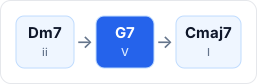
- Extended harmony — jazz is built on 7th chords (four notes) and their extensions, not the plain three-note triads of a lot of pop and folk. Cmaj7 is C–E–G–B; Dm7 is D–F–A–C; G7 is G–B–D–F.
Those three 7th chords line up into the single most important progression in the music, the ii–V–I:
What is a lead sheet?
A lead sheet is a one-page chart that shows only the melody (written on the staff) and the chord symbols above it — nothing about the accompaniment is spelled out. It is a set of instructions, not a finished performance: the chords tell you what to play, and it is up to you to decide how — which voicing, which rhythm, which notes to leave out.
The most famous collection of lead sheets is the Real Book. Because so little is written down, two pianists reading the same lead sheet will produce two completely different-sounding versions of the same tune — and both are "correct."
What is the head–solos–head form?
Most jazz performances follow one simple road map: play the tune, take turns improvising over it, then play the tune again to end. In more detail:
- Head — the whole band plays the written melody (the "head") once or twice through.
- Solos — one player at a time improvises new melodies over the same chord changes, for as many rounds ("choruses") as they like, while the others accompany.
- Head (out) — the band returns to the written melody to signal the end.
The chord progression stays the same the entire time; what changes is who is inventing a line over the top of it.
What's the difference between comping and soloing?
At the piano you are always doing one of two jobs. Comping is accompanying — you supply the harmony and rhythm underneath whoever is soloing. Soloing is improvising the lead melodic line yourself while the rest of the band comps for you.
- Comping (from "accompanying"): play the chords with a rhythmic feel that supports the soloist — usually rootless voicings in the right hand, staying out of the bass player's way, leaving space rather than filling every beat.
- Soloing: build an improvised melody over the chord changes, using the scales and chord tones that fit each chord.
Nearly everything in this course serves one or both of these jobs.
Where does this course go from here?
This is the first of six sections. The rough road map:
- Getting started (you are here) — what jazz is, the theory you need, and how to practice.
- Rhythm & feel — swing, comping rhythms, and time.
- Harmony — 7th chords, the ii–V–I, voicings, and chord extensions.
- Voicings — shell voicings, rootless voicings, and voice leading at the keyboard.
- Improvisation — scales, chord tones, and building solo lines.
- Repertoire — putting it together on real standards.
Listen
- Bill Evans Trio — "Waltz for Debby" (live, 1961) — a classic piano-trio recording. Notice how the piano comps behind the melody, then solos, while bass and drums keep the swing.
Practice
- Put on one jazz piano-trio track (the Bill Evans recording above works well). Tap along on beats 2 and 4 — not 1 and 3. This is where jazz "sits," and getting your body to feel it is step one.
- Listen through once more and try to hear when the piano is comping and when it is soloing. You do not need to name anything — just notice the two roles.
Common mistakes
- Trying to read every note. Jazz is played from chord symbols and your ears, not a fully notated part. If you are waiting for the sheet music to tell you exactly what to play, you will wait forever — the chart deliberately leaves that to you.
- Ignoring the feel. Playing the right notes with a stiff, straight, on-the-beat rhythm still will not sound like jazz. The swing feel is not decoration; it is half the style.
- Skipping straight to soloing. Comping is the job you will do most of the time in a band. Learn to accompany before you worry about taking flashy solos.
Frequently asked questions
Do I need to read music to play jazz? Not fluently. You need to read chord symbols (like Dm7 or G7) and ideally follow a simple melody line, but jazz is learned far more by ear and from chord charts than by sight-reading dense notation. Basic reading helps; virtuoso sight-reading is not a prerequisite.
What is a lead sheet? A one-page chart with just the melody and chord symbols — no written-out accompaniment. It tells you the tune and the harmony and leaves the actual arrangement (voicings, rhythm, texture) up to you.
What's the difference between comping and soloing? Comping is accompanying — playing the chords and rhythm under someone else's melody or solo. Soloing is improvising the lead melodic line yourself while the band comps for you. As a jazz pianist you switch between the two constantly.
Next up: Jazz prerequisites — the exact music theory you should have under your fingers before diving in.