
Shell Voicings
Updated: 2026-07-06You don't need all four notes of a seventh chord to make it sound like that chord. Two notes — the 3rd and the 7th — carry the identity. These stripped-down shell voicings are the first thing a jazz pianist learns to comp with, because they're easy, they sound right, and they stay out of everyone's way.
Key takeaways
- A shell = the 3rd + the 7th of the chord — the two notes that define its quality.
- The 3rd tells you major/minor; the 7th tells you the chord type — the root and 5th are optional.
- Shells are ideal for comping behind a soloist and when a bass covers the root.
- From C: Cmaj7 shell = E–B, Dm7 = F–C, G7 = E–B♭.
Why do just two notes work?
Because the 3rd and 7th are the notes that distinguish one chord quality from another. The root is usually covered by the bass, and the 5th adds almost no information. Drop them and you're left with a lean two-note shell that still unmistakably says "Dm7" or "G7."
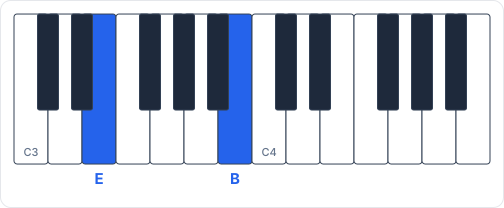
How do I play shells through a ii–V–I?
Put the shells in the left hand and let them voice-lead smoothly. Through Dm7 – G7 – Cmaj7 in C:
Notice how little the hand moves — the C in Dm7 slides to B♭ in G7, then up to B in Cmaj7; the F drops to E and stays. Small motion, big harmonic clarity.
Listen
- Bud Powell recordings — the classic sound of sparse left-hand shells behind a bebop line.
- Shell voicing on Wikipedia — voicing basics.
Practice
Play the shells for a ii–V–I in C (F–C, E–B♭, E–B) in the left hand, keeping the motion as small as possible. Then take the same shells around all 12 keys.
Common mistakes
- Adding the 5th "to be safe" — it's redundant and clutters the shell.
- Playing shells too high, where they sound thin — keep them in the middle-low register.
- Leaping to a new root-position shape each chord instead of voice-leading the two notes smoothly.
Frequently asked questions
Why only two notes? Because the 3rd and 7th alone define the chord's quality (major, minor, dominant), and in a band the bass supplies the root. Two notes are enough to state the harmony clearly while leaving space — which is exactly what good comping does.
When should I use shells? When you're comping behind a soloist (they leave room), when a bass player is covering the root, or any time you want a clean, uncluttered sound. They're also the perfect starting point before you add the fuller rootless voicings in the next lesson.
Ready for a fuller sound? Continue with Rootless Voicings.