The Bebop Scale
Updated: 2026-07-06Play a seven-note scale in steady eighth notes and the chord tones drift onto the weak beats — it sounds lumpy. The bebop scale fixes this with one added chromatic note, so the chord tones land squarely on the beat and your fast lines swing.
Key takeaways
- A bebop scale = a regular scale plus one chromatic passing note.
- The dominant bebop scale = Mixolydian + a passing natural 7.
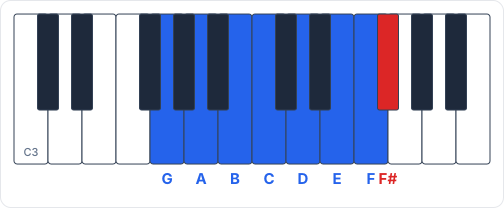
- From G: G A B C D E F F♯ — the added F♯ is the passing tone.
- The extra note makes chord tones fall on the beat in eighth-note runs.
This builds on Jazz Scales.
What makes a scale a "bebop" scale?
A regular seven-note scale has an odd number of notes, so in continuous eighths the chord tones and non-chord tones swap places every bar. Adding an eighth (chromatic) note fixes the count, so chord tones consistently land on the strong beats. The dominant bebop scale adds a passing natural 7 to the Mixolydian mode. From G (tonal calls this the "bebop" scale): G A B C D E F F♯.
Where does the extra note go?
It's a passing note — you play through it, never stopping on it, so it connects the ♭7 (F) up to the root (G). Descending from the root in straight eighths, the chord tones G, E, D, B now all fall on the beat because the F♯ absorbs the extra half step.
Listen
- Bebop scale on Wikipedia — the concept and its history.
- Charlie Parker or Bud Powell lines — the sound of chord tones nailing the beats at speed.
Practice
Run the G bebop scale down over a G7, in swung eighths, checking that G, E, D, and B land on the beats. Then apply it to the V chord of a ii–V–I and take it through all 12 keys.
Common mistakes
- Adding the passing note randomly instead of using it to align chord tones with the beat.
- Stopping on the chromatic passing note — it should be passed through.
- Forgetting the whole point: it's a rhythmic device, not just an extra note to memorize.
Frequently asked questions
What makes a scale a "bebop" scale? An added chromatic passing note that brings the scale to eight notes per octave. Because eight divides evenly into a bar of eighth notes, the chord tones consistently land on the strong beats — which is exactly what makes bebop lines swing and sound "correct" at speed.
Where does the extra note go? In the dominant bebop scale it sits between the ♭7 and the root (F♯ between F and G in G bebop), used as a passing tone on the way up or down. You never land on it; it just fills the gap so the chord tones stay on the beat.
Now let's turn scales into actual solo lines — continue with Guide Tones & Improvisation.