Seventh Chords in Jazz
Updated: 2026-07-06Play a plain C–E–G triad and it sounds fine — but it doesn't sound like jazz. Add one more note a third on top, the seventh, and the chord suddenly has color and pull. That extra note is why jazz is built almost entirely on seventh chords rather than triads.
Key takeaways
- Jazz harmony runs on seventh chords — a triad plus a note a third above the fifth.
- Five core qualities cover most of the repertoire: maj7, m7, dominant 7, m7♭5 (ø), and °7.
- All five appear naturally as the diatonic seventh chords of a major key.
- The m7♭5 (half-diminished) and °7 (fully-diminished) are easy to confuse — the difference is the seventh.
- The seventh is what turns a bland triad into a jazz chord — never leave it out.
This lesson assumes you already know how sevenths are built. If not, review Seventh Chords first.
What are the five core seventh-chord qualities?
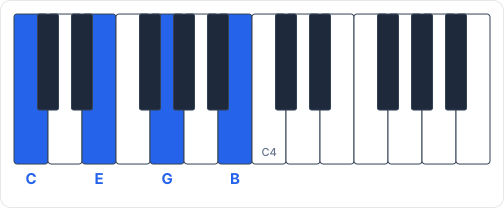
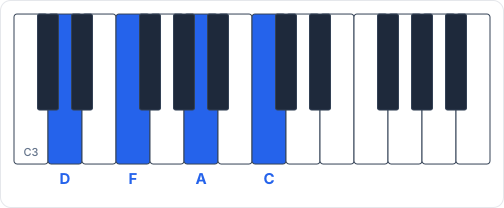
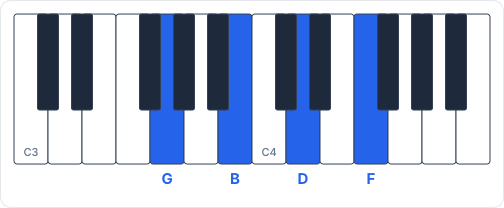
The five are major 7th, minor 7th, dominant 7th, half-diminished (m7♭5), and fully-diminished (°7) — each defined by the triad underneath and the size of the seventh on top. Built from C and verified with tonal:
| Quality | Symbols | Notes from C |
|---|---|---|
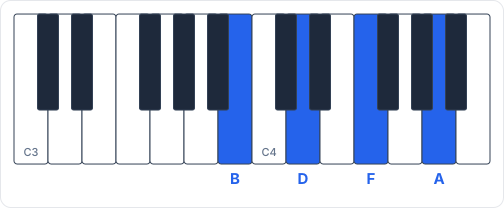
| Major 7th | Cmaj7, CΔ7, CM7 | C–E–G–B |
| Minor 7th | Cm7, C−7 | C–E♭–G–B♭ |
| Dominant 7th | C7 | C–E–G–B♭ |
| Half-diminished 7th | Cm7♭5, Cø7 | C–E♭–G♭–B♭ |
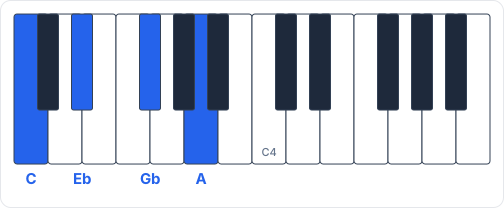
| Fully-diminished 7th | C°7, Cdim7 | C–E♭–G♭–B𝄫 (= A) |
Each keyboard below shows one quality laid out under the hand:
How do these qualities arise from a major key?
Stack a seventh on each degree of the major scale and you get the same seven-chord pattern every time — and it already contains four of the five qualities. Building sevenths on C major (verified with tonal):
| Degree | Chord | Quality |
|---|---|---|
| I | Cmaj7 | major 7th |
| ii | Dm7 | minor 7th |
| iii | Em7 | minor 7th |
| IV | Fmaj7 | major 7th |
| V | G7 | dominant 7th |
| vi | Am7 | minor 7th |
| vii | Bm7♭5 | half-diminished |
Only one quality — the fully-diminished °7 — is not diatonic to the major scale; it comes from harmonic minor and is used as a passing or leading chord. Notice that the dominant 7th appears only once, on the V: that uniqueness is exactly why it signals "this is the V, and it wants to go home."
Listen
- Wikipedia: Seventh chord — audio examples of each quality.
- Wikipedia: Dominant seventh chord — hear the tension of the dominant.
Practice
Build all seven diatonic seventh chords of C major up the scale and name the quality of each out loud (maj7, m7, m7, maj7, dominant 7, m7, m7♭5). Then do it in all 12 keys, one key per day around the circle of fourths.
Common mistakes
- Confusing m7♭5 (ø) with °7 — both sit on a diminished triad, but ø has a minor seventh while °7 has a diminished seventh (a half step lower).
- Forgetting the seventh and playing a bare triad — the seventh is what makes it a jazz chord.
- Reading "C7" as a major-seventh chord. Plain 7 means the dominant (minor) seventh; the major seventh is written maj7 / Δ7.
Frequently asked questions
Why 7th chords instead of triads in jazz? Triads are stable and a little plain; adding the seventh introduces a mild dissonance that gives each chord color and, on dominants, a strong pull toward resolution. Jazz harmony is a conversation of tension and release, so the seventh is the baseline vocabulary — the triad is only the starting point.
What's the difference between ø7 and °7? Both are built on a diminished triad (from C: C–E♭–G♭). The half-diminished (ø7 / m7♭5) adds a minor seventh (B♭ from C). The fully-diminished (°7) adds a diminished seventh (B𝄫, enharmonically A, from C) — a half step lower. So Cø7 = C–E♭–G♭–B♭, while C°7 = C–E♭–G♭–A.
Once these five qualities feel automatic, the next step is to color them — continue with Chord Extensions & Tensions.