
Rootless Voicings
Updated: 2026-07-06Shells are lean; sometimes you want something lush. Rootless voicings — pioneered by Bill Evans — drop the root (the bass has it) and use the freed-up fingers for the 3rd, 5th, 7th, and a tension like the 9th. The result is the rich, floating left-hand sound of modern jazz piano.
Key takeaways
- Rootless = leave out the root (the bass covers it) and voice 3-5-7-9 or 7-9-3-5.
- Two shapes — the "A" and "B" voicings — alternate so the hand barely moves through changes.
- They sound fuller than shells while still leaving space.
- Major ii–V–I in C: Dm7 F–A–C–E, G7 F–A–B–E, Cmaj7 E–G–B–D.
This builds on Shell Voicings.
What is a rootless voicing?
It's a four-note left-hand voicing that omits the root and includes an extension. Instead of root-3-5-7 you play 3-5-7-9 (the "A" shape) or 7-9-3-5 (the "B" shape). The bass player — or your own bass note — supplies the root, so nothing is missing.
How do the A and B shapes move through a ii–V–I?
The two shapes are designed so that, when you alternate them, the voices move by the smallest possible steps. Through Dm7 – G7 – Cmaj7 in C:
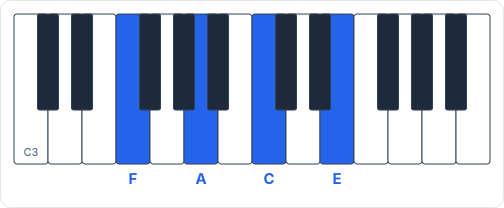
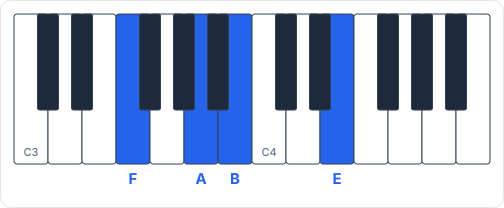
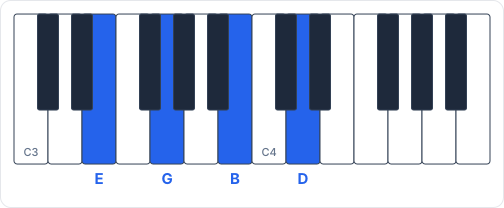
From Dm7 to G7 only one note changes (C→B); from G7 to Cmaj7 just two move. That smoothness is the whole point.
You can also move the other way: start with the B shape, move to A, then return to B. The colors are the same rootless vocabulary, just placed in a different register:
In the B–A–B version, Dm7 begins with the 7th and 9th at the bottom; G7 keeps E–F–A and moves C down to B; Cmaj7 keeps B–E while A drops to G and F drops to D. Same principle: move as few notes as possible and keep the hand close.
Listen
- Bill Evans, "Waltz for Debby" — the definitive rootless-voicing sound.
- Bill Evans on Wikipedia — who developed this approach.
Practice
Play the ii–V–I above both ways: A–B–A and B–A–B. Alternate A and B shapes and keep the motion tiny. Then take it around all 12 keys.
Common mistakes
- Playing rootless voicings with no bass underneath — without a root somewhere the chord is incomplete and floats.
- Jumping between root-position shapes instead of alternating A/B for smooth voice leading.
- Voicing them too low so the 9th turns to mud — keep them around middle C and up.
Frequently asked questions
What's the difference between the A and B voicings? They're two arrangements of the same notes: the "A" shape stacks 3-5-7-9 from the bottom, the "B" shape stacks 7-9-3-5. Alternating them through a progression keeps the hand in one position and the voices moving by step instead of by leap.
Do I need a bass player to use rootless voicings? Ideally the root should sound somewhere — a bassist, your left-hand bass note, or a backing track. Solo and unaccompanied, add an occasional root so the harmony doesn't float; with a bass, pure rootless voicings sound great.
Now let's look closely at why these voicings connect so smoothly — continue with Voice Leading Through ii–V–I.