
The Blues Scale & Form
Updated: 2026-07-06The blues is the root of jazz, and two things carry its sound: the blues scale and the 12-bar blues form. Together they're the friendliest place to start improvising — one scale works over the whole form, so you can make music immediately.
Key takeaways
- The blues scale = minor pentatonic + the ♭5 "blue note".
- From C: C E♭ F G♭ G B♭ — the G♭ is the blue note.
- The 12-bar blues is a fixed 12-measure form on I7, IV7, and V7.
- One blues scale works over the entire 12 bars — the easiest first solo.
This builds on Pentatonic Scales in Jazz.
What is the blues scale?
It's the minor pentatonic with one extra note — the flat 5th, the "blue note" that gives the blues its aching sound. From C (verified with tonal): C E♭ F G♭ G B♭.
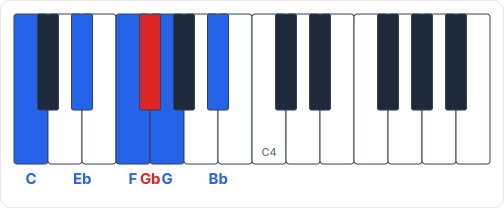
The blue note is usually passed through or bent into, not landed on — it's a splash of tension between F and G.
What are the 12-bar blues changes?
The 12-bar blues is a 12-measure form built on the I, IV, and V chords — all as dominant 7ths, which is the bluesy twist. In C those are C7, F7, and G7:
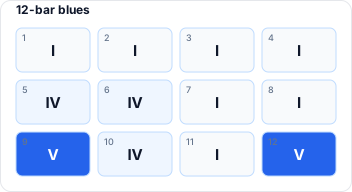
The magic for beginners: the C blues scale works over the whole form — every chord — so you can solo through all 12 bars with one scale.
Listen
- Blues scale on Wikipedia — its sound and variants.
- Any jazz or B.B. King blues — hear the blue notes bent and leaned on.
Practice
Play a 12-bar blues in C with your left hand (C7, F7, G7) and solo with the C blues scale in your right, leaning on the blue note (G♭). Then move the whole thing through all 12 keys.
Common mistakes
- Using the blues scale over everything — it's a color, not a universal solution.
- Landing hard on the blue note instead of passing through or bending it.
- Playing the blues "straight" — the blues lives in the swing and the feel.
Frequently asked questions
What is the blues scale? The minor pentatonic with an added flat-5th "blue note." From C it's C–E♭–F–G♭–G–B♭. That extra ♭5 sitting between the 4th and 5th is what gives the blues its characteristic tension and soul.
What are the 12-bar blues changes? A fixed 12-bar form using I7, IV7, and V7 (in C: C7, F7, G7). A basic pattern is four bars of I7, two of IV7, two of I7, then V7–IV7–I7–V7. All three chords are dominant sevenths — a signature of the blues.
Next, a scale that makes fast bebop lines line up perfectly — continue with The Bebop Scale.