Pentatonic Scales in Jazz
Updated: 2026-07-06If seven-note modes feel like a lot to manage while soloing, the pentatonic scales are your shortcut. Five notes, no half steps, nothing that clashes — pentatonics are the safest, most singable material you can improvise with, and pros use them constantly.
Key takeaways
- Pentatonics have five notes and no semitone clashes — everything sounds consonant.
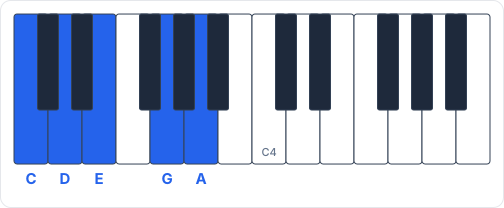
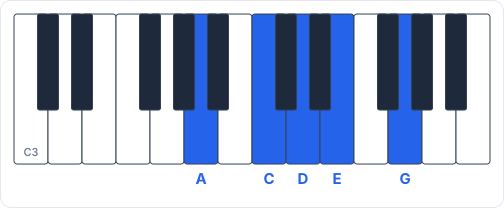
- Major pentatonic (C D E G A) and minor pentatonic (A C D E G) are the two core shapes.
- They're the same five notes: A minor pentatonic is C major pentatonic started on A.
- Choosing a pentatonic a step or two away from the root adds color over a chord.
This builds on Jazz Modes.
What are the major and minor pentatonics?
The major pentatonic is the major scale without its 4th and 7th — the two notes most likely to clash. The minor pentatonic is the same five notes starting on the relative minor. Verified with tonal:
Which pentatonic do I use over which chord?
The obvious choice is the pentatonic that matches the chord's root (C major pentatonic over Cmaj7). But you get richer colors by picking one a step or a fifth away — for example, G major pentatonic over Cmaj7 brings out the 9, 13, and major 7 for a bright, modern sound.
Listen
- Pentatonic scale on Wikipedia — the sound and its worldwide use.
- Modern players like Chick Corea — pentatonics stacked for color.
Practice
Solo one chorus over a C ii–V–I using only C major pentatonic. Then try G major pentatonic over the Cmaj7 and hear the brighter color. Then move it through all 12 keys.
Common mistakes
- Only ever using the minor pentatonic (the "blues box") over everything.
- Ignoring the underlying changes — even safe notes need to connect to the harmony.
- Running the pentatonic mechanically up and down instead of shaping phrases.
Frequently asked questions
Which pentatonic do I use over which chord? Start with the one built on the chord's root (C major pentatonic over C major chords). For more color, choose a pentatonic a whole step or a fifth up — G major pentatonic over Cmaj7 highlights the upper extensions. Over a minor chord, the minor pentatonic on the root is the safe default.
Why are pentatonics "safe"? They omit the half-step clashes (the 4th and 7th of the major scale), so no note sits a semitone from a chord tone. That means almost anything you play sounds consonant, which makes pentatonics perfect for building confident, singable lines.
Next, the scale that adds grit and soul — continue with The Blues Scale & Form.