Jazz Prerequisites
Updated: 2026-07-06Jazz has a reputation for being fiendishly complex, but the theory you need to start is short and concrete. Every voicing, ii–V–I, and solo line you will learn is assembled from a handful of fundamentals you may already know. This lesson lists exactly what those are, so you can spot your gaps and fill them before they slow you down at the keyboard.
Key takeaways
- You need five things: the major scale, intervals, triads, 7th chords, and chords-in-a-key / Roman numerals.
- 7th chords are the non-negotiable one — jazz harmony is built on four-note chords, not triads.
- The seven diatonic 7th chords of C major are Cmaj7, Dm7, Em7, Fmaj7, G7, Am7, Bm7♭5.
- You do not need to have mastered all of this — you need to be comfortable enough to build on it.
- Every prerequisite below links to a full music-theory lesson if you want to review.
What theory do you actually need before jazz?
Five building blocks, in order of how much they matter. Each has a one-line recap and a link to the full lesson.
1. The major scale (and the 12 keys)
The major scale is the seven-note ruler (W–W–H–W–W–W–H) that everything else is measured against; jazz asks you to know it in all 12 keys, not just C. → Major scales & keys
2. Intervals
An interval is the distance between two notes (a major 3rd, a perfect 5th, a minor 7th); chords are just stacks of intervals, so naming them quickly is a core skill. → Intervals
3. Triads
A triad is a three-note chord built in 3rds — root, 3rd, 5th (C–E–G is a C major triad); it is the skeleton you add a 7th onto. → Triads
4. Seventh chords — the essential one
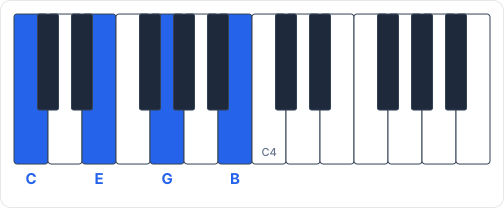
A 7th chord adds a fourth note, a 7th above the root, to a triad — this four-note sound is the basic vocabulary of jazz. Cmaj7 is C–E–G–B; Dm7 is D–F–A–C; G7 is G–B–D–F. → Seventh chords
5. Chords in a key & Roman numerals
Building a 7th chord on each degree of a key gives you its diatonic chords, labelled with Roman numerals (Imaj7, ii7, V7…) so a progression can be described independently of key. → Roman numerals & cadences
In C major, stacking 7ths on each scale degree produces exactly these seven chords (verified with tonal):
| Degree | Roman numeral | Chord | Notes |
|---|---|---|---|
| 1 | Imaj7 | Cmaj7 | C–E–G–B |
| 2 | ii7 | Dm7 | D–F–A–C |
| 3 | iii7 | Em7 | E–G–B–D |
| 4 | IVmaj7 | Fmaj7 | F–A–C–E |
| 5 | V7 | G7 | G–B–D–F |
| 6 | vi7 | Am7 | A–C–E–G |
| 7 | vii7♭5 | Bm7♭5 | B–D–F–A |
Notice the pattern: two major-7th chords (I and IV), three minor-7th chords (ii, iii, vi), one dominant-7th chord (V), and one half-diminished (vii). That pattern is identical in every major key — which is exactly why practicing in all 12 keys pays off.
Listen
- Miles Davis — "So What" — famously built on just two chords (Dm7 and E♭m7). Proof that a small chord vocabulary, used well, is enough to make great jazz.
Practice
- Spell the seven diatonic 7th chords of C major out loud, note by note, then check yourself with
tonal: runnode -e "const{Key}=require('tonal'); console.log(Key.majorKey('C').chords)"from the repo root. - Once C is easy, do the same in all 12 keys, one key per day around the circle of fourths (C, F, B♭, E♭, …). Say each chord and its Roman numeral.
Common mistakes
- Skipping 7th chords. This is the big one. Jazz harmony is built on four-note chords, not triads — if you only know triads, most lead sheets will look wrong under your hands.
- Only ever working in C. The theory is identical in every key, but your fingers aren't. Learning it only in C means relearning everything the first time a tune is in E♭.
- Waiting to feel "ready." You do not need to master all five topics first. Get comfortable enough to build on them, then learn the rest as jazz demands it.
Frequently asked questions
How much theory do I need before jazz? Enough to comfortably build and name 7th chords in any key, plus the major scale, intervals, triads, and the diatonic chords/Roman numerals of a key. You do not need advanced counterpoint or classical harmony — jazz teaches most of its own harmony as you go.
Which music-theory lessons should I do first? In order: major scales & keys → intervals → triads → seventh chords → Roman numerals & cadences. If you are short on time, make sure seventh chords is solid — it matters most.
Next up: How to practice jazz — how to turn this theory into something your hands actually own.