Seventh Chords
Updated: 2026-07-04A seventh chord is a triad with one more note added a third above the fifth — the seventh. Because chords are stacked in thirds, their members are odd numbers: root, 3rd, 5th, 7th (and later 9th, 11th, 13th).
Key takeaways
- A seventh chord is a triad plus a note a third above the fifth — the seventh.
- There are five common types: major 7th, dominant 7th, minor 7th, half-diminished, and fully-diminished.
- Quality comes from the triad beneath and the quality of the seventh above the root.
- Roman numerals: add "7" = minor seventh, "M7" = major seventh, ø7 = half-diminished, °7 = fully-diminished.
- V7 is the dominant seventh — the strongest tension demanding resolution to I.
What are the five common seventh chords?
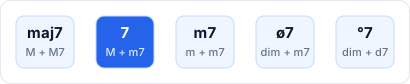
The five are the major 7th, dominant 7th, minor 7th, half-diminished, and fully-diminished — each set by the triad beneath it and the quality of the seventh above the root. A seventh chord's quality depends on the quality of the triad beneath it and the quality of the seventh above the root. The table below is built from C and verified with tonal:
| Type | Symbol | Triad + seventh | Notes from C |
|---|---|---|---|
| Major 7th | Cmaj7 (C△7, CM7) | major + M7 | C–E–G–B |
| Dominant (major-minor) 7th | C7 | major + m7 | C–E–G–B♭ |
| Minor 7th | Cm7 | minor + m7 | C–E♭–G–B♭ |
| Half-diminished 7th | Cø7 (Cm7♭5) | diminished + m7 | C–E♭–G♭–B♭ |
| Fully-diminished 7th | C°7 (Cdim7) | diminished + d7 | C–E♭–G♭–B𝄫 |
Note the difference between half-diminished and fully-diminished: both sit on a diminished triad, but the half-diminished has a minor 7th while the fully-diminished has a diminished 7th (a half step lower still).
How do you write sevenths as Roman numerals?
Keep the uppercase/lowercase triad convention, then add a suffix for the quality of the seventh. Conventions for writing seventh chords with Roman numerals:
- Uppercase = major triad, lowercase = minor triad (as with triads).
- Add "7" = a minor seventh between root and seventh (e.g. V7).
- Add "M7" = a major-seventh chord (e.g. IM7).
- ø7 = half-diminished; °7 = fully-diminished.
Major key (C major):
| IM7 | ii7 | iii7 | IVM7 | V7 | vi7 | viiø7 |
|---|---|---|---|---|---|---|
| Cmaj7 | Dm7 | Em7 | Fmaj7 | G7 | Am7 | Bø7 |
Minor key (A minor — using the raised 7th for V7 and vii°7):
| i7 | iiø7 | IIIM7 | iv7 | V7 | VIM7 | vii°7 |
|---|---|---|---|---|---|---|
| Am7 | Bø7 | Cmaj7 | Dm7 | E7 | Fmaj7 | G♯°7 |
The V7 (dominant seventh) is especially important: its minor seventh adds tension that demands resolution to I, making V7–I the strongest harmonic drive in tonal music.
See Triads and Roman Numerals & Cadences for the fundamentals, then Harmonic Progression & Function to see how these chords move.
Frequently asked questions
How do half-diminished and fully-diminished sevenths differ? Both sit on a diminished triad, but the half-diminished (Cø7) has a minor seventh while the fully-diminished (C°7) has a diminished seventh — a half step lower still.
Why is V7 so important? Its minor seventh adds tension that demands resolution to I, which makes V7–I the strongest harmonic drive in tonal music.
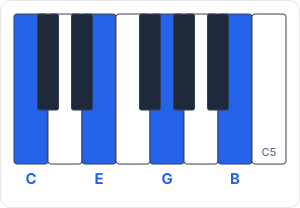
What notes are in a major-seventh chord from C? Cmaj7 = C–E–G–B: a major triad (C–E–G) plus a major seventh (B) above the root.