
Melodic Analysis
Updated: 2026-07-04A melody is not a random string of notes: it is built from short musical ideas that are repeated and varied. Melodic analysis is learning to recognize those ideas and the techniques composers use to develop them.
Key takeaways
- A motive is the smallest identifiable musical idea — often just a few notes — and an entire movement can grow from one.
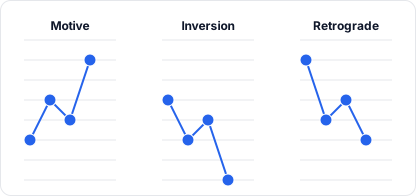
- Composers alter motives (inversion, retrograde, augmentation, diminution, and more) for variety with unity.
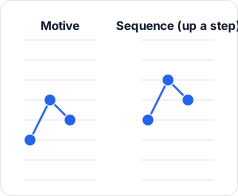
- A sequence restates an idea at a new pitch level; it's so common it's usually not labeled an "alteration."
- A compound motive can be split into fragments that are developed independently.
- A phrase is the smallest formal unit that feels complete; a subphrase is a smaller member within it.
What is a motive?
A motive is the smallest identifiable musical idea in a piece — often just a few notes. An entire movement can grow from a single motive (think of the four opening notes of Beethoven's Symphony No. 5).
What are the ways to alter a motive?
Composers rarely repeat a motive unchanged; they alter it to create variety while keeping unity. Here are the most common techniques:
| Technique | Description |
|---|---|
| Inversion | Flip the direction of the intervals: up becomes down |
| Retrograde | Reverse the order of the notes (play it backward) |
| Augmentation | Lengthen the note durations (often doubled) |
| Diminution | Shorten the note durations |
| Intervallic change | Keep the contour but change some intervals |
| Rhythmic change | Keep the pitches but change some durations |
| Ornamentation | Add non-chord tones as decoration |
| Extension | Add material to the end of the motive on repetition |
Transposition (a sequence — restating an idea at a different pitch level) is so common that it is usually not labeled as a distinct alteration.
What is a fragment?
A fragment is a piece of a larger motive that can be worked on by itself. A "compound" motive can be broken into fragments (sometimes called "germs"), and each one can be developed independently, giving the composer more material to work with.
How do a phrase and a subphrase differ?
A phrase is the smallest unit that feels complete, while a subphrase is just a member within a phrase.
- A phrase is the smallest formal unit that gives a sense of completion. In classical music a phrase always ends with a cadence; in popular music a phrase is often about four measures long or a complete line of lyric.
- A subphrase is a smaller unit within a phrase — a "member" of the phrase that is not yet complete enough to stand alone.
Most phrases are four measures long (sometimes eight), but you will also meet 3-, 5-, 6-, and 7-measure phrases.
See Phrases in Combination for how phrases combine into larger structures.
Frequently asked questions
How is a motive different from a phrase? A motive is the smallest identifiable musical idea (often just a few notes), while a phrase is a larger formal unit that feels complete — in classical music it always ends with a cadence.
Is a sequence a type of motivic alteration? Technically yes, but because transposition (restating an idea at a new pitch level) is so common, it's usually not labeled as a distinct "alteration."
What's the difference between inversion and retrograde? Inversion flips the direction of the intervals (up becomes down), while retrograde reverses the order of the notes (you play it backward).