
Form in Popular Music
Updated: 2026-07-04Form is a song's overall blueprint — the order and repetition of its sections. Understanding form lets you hear the "big picture" instead of just isolated measures.
Key takeaways
- Form is a song's overall blueprint — the order and repetition of its sections.
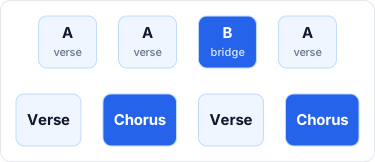
- A verse keeps the music but changes the lyrics; a chorus (the hook) keeps both music and lyrics.
- Common forms: verse–chorus, AABA (32-bar), ABAC, and the 12-bar blues.
- The 12-bar blues is a fixed harmonic cycle built on I, IV, and V.
- A closed section ends on I (stable); an open section ends elsewhere (usually V) to push into the next.
What sections make up a song?
Popular music is assembled from sections with different jobs — each one plays a distinct role:
| Section | Role |
|---|---|
| Intro | Opens the song, often without vocals |
| Verse | Same music, different lyrics each time |
| Pre-chorus | Builds energy, leads into the chorus |
| Chorus | The song's "hook" — same music and lyrics each time |
| Bridge | Contrasting material, usually heard once |
| Interlude | An instrumental passage between sections |
| Outro | The closing section |
Which forms are most common?
These four cover most popular music, from modern pop/rock to jazz standards and blues:
- Verse–chorus: alternating verses and choruses; the most common form in modern pop/rock.
- AABA (32-bar form): two A sections, a contrasting B section (bridge), then A returns — the backbone of many jazz standards and Tin Pan Alley songs.
- ABAC: common in older pop, with no section repeating verbatim like a chorus.
- 12-bar blues: a fixed 12-measure blues harmonic cycle.
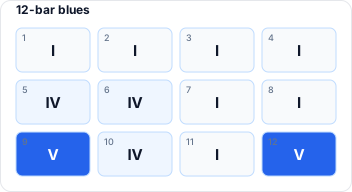
A typical 12-bar blues progression (in Roman numerals):
| Measure | 1–4 | 5–6 | 7–8 | 9 | 10 | 11 | 12 |
|---|---|---|---|---|---|---|---|
| Chord | I | IV | I | V | IV | I | V |
What do "harmonically closed" and "open" mean?
They describe how a section ends: closed when it lands on the tonic, open when it ends on some other chord that demands to move on. A section can be harmonically closed or open:
- Harmonically closed: ends on the tonic chord (I) → a stable, complete feeling.
- Harmonically open: ends on a chord that is not the tonic (usually V) → creates a push into the next section.
For example, in "We Are the World" the verse and bridge are harmonically open (ending on V), while the chorus is harmonically closed (ending on I). Placing open and closed sections thoughtfully is key to a song's flow.
See Roman Numerals & Cadences for I, IV, and V, and Phrases in Combination for the smaller structural level.
Frequently asked questions
What's the difference between a verse and a chorus? A verse keeps the same music but uses different lyrics each time, while the chorus — the song's hook — keeps both the music and the lyrics every time it returns.
What is AABA form? It's a 32-bar form with two A sections, a contrasting B section (bridge), then a return of A — the backbone of many jazz standards and Tin Pan Alley songs.
Which chords does the 12-bar blues use? A fixed 12-measure cycle built on just three chords, I, IV, and V — for example I (bars 1–4) – IV (5–6) – I (7–8) – V (9) – IV (10) – I (11) – V (12).