Triads
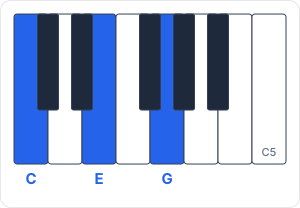
Updated: 2026-07-04A triad is three notes stacked in consecutive thirds — the most basic unit of harmony. When stacked properly in thirds, the lowest note is the root, the middle note is the third, and the top note is the fifth.
Key takeaways
- A triad is three notes stacked in thirds: root, third, and fifth.
- The two stacked thirds decide the four qualities: major, minor, diminished, and augmented.
- Lead-sheet symbols give the root and quality (F, Gm, D°, C+); the player chooses the voicing.
- When the bass isn't the root, the triad is inverted and written as a slash chord like C/E.
- A sus chord swaps the third for a 4th (sus4) or a 2nd (sus2), so it's neither major nor minor.
What are the four triad qualities?
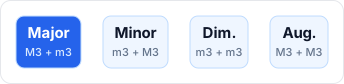
There are four qualities — major, minor, diminished, and augmented — and which one you get depends on whether the two stacked thirds are major (M3) or minor (m3). The table below is built from C and verified with tonal:
| Quality | Structure | Symbol | Notes from C |
|---|---|---|---|
| Major | M3 then m3 | C | C–E–G |
| Minor | m3 then M3 | Cm | C–E♭–G |
| Diminished | m3 then m3 | C° | C–E♭–G♭ |
| Augmented | M3 then M3 | C+ | C–E–G♯ |
Major and minor triads are very common; diminished triads are less common, and augmented triads are rare.
How do you read lead-sheet symbols?
Read the letter as the root and the suffix as the quality; everything else is up to the player. Lead-sheet symbols are a shorthand for chords used in popular music and jazz — they communicate the root and quality of a chord, while the performer chooses how to "voice" (arrange) the notes.
| Symbol | Quality | Notes |
|---|---|---|
| F | major | F–A–C |
| Gm | minor | G–B♭–D |
| D° | diminished | D–F–A♭ |
| C+ | augmented | C–E–G♯ |
By convention: a major triad is an uppercase letter (F), a minor triad adds "m" (Gm), a diminished triad adds the ° symbol (D°), and an augmented triad adds + (C+).
What are inversions and slash chords?
An inversion is when the lowest sounding note isn't the root, and a slash chord is how you write that on a lead sheet. Distinguish the root (the lowest note when stacked in thirds) from the bass (the note that actually sounds lowest). If the bass is not the root, the triad is inverted:
- Root position: the root is on the bottom.
- First inversion: the third is on the bottom.
- Second inversion: the fifth is on the bottom.
In lead-sheet notation, an inversion is written as a slash chord: the letter before the slash is the chord, the letter after it is the bass. For example, C/E means a C triad with E in the bass.
How is a "sus" chord different from a plain triad?
A sus chord drops the third — the note that decides major vs. minor — so it sounds open and unresolved. Sus chords (short for suspended) are common in popular music. A sus chord replaces the third with another note, so the chord is neither major nor minor:
- sus4 (often written just "sus"): a perfect 4th replaces the third. Csus4 = C–F–G.
- sus2: a major 2nd replaces the third. Csus2 = C–D–G.
Both keep the perfect 5th from root to fifth.
See Intervals to review major/minor thirds, and Roman Numerals & Cadences for how these chords function within a key.
Frequently asked questions
What makes a triad major versus minor? It's the order of the two thirds: a major triad stacks M3 then m3 (C–E–G), while a minor triad stacks m3 then M3 (C–E♭–G). Only the third changes.
What does C/E mean? It's a slash chord: a C triad in first inversion, with E (the third) in the bass. The letter before the slash is the chord, the one after is the bass note.
What notes are in Csus4 and Csus2? Csus4 = C–F–G (a perfect 4th replaces the third) and Csus2 = C–D–G (a major 2nd replaces the third). Both keep the perfect 5th.