
Voice Leading Seventh Chords
Updated: 2026-07-04A seventh chord adds a dissonant note — the seventh — to a triad. That dissonance calls for special handling in voice leading.
Key takeaways
- The seventh is a dissonance, so it always resolves down by step.
- In V⁷ → I: the leading tone goes up, the seventh goes down.
- As a result the I chord is usually missing its fifth (with a tripled root) — that's normal.
- In a circle-of-fifths chain, each seventh resolves down to become the third of the next chord.
- The chords typically alternate complete and incomplete to avoid parallels.
Why does the seventh always resolve down?
Because the seventh is the note that creates the tension, so the ear expects it to fall for release. The core rule for voice-leading seventh chords: the seventh resolves down by step. Because the seventh is the note that creates tension, the ear expects it to "fall" for release — letting it leap up sounds unstable.
How does V⁷ resolve to I?
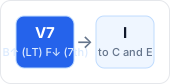
The leading tone rises to the tonic while the seventh falls to the third of I, so both tense notes release. This is the most important resolution in tonal music:
- The leading tone (scale degree 7, the third of V⁷) moves up by step to the tonic.
- The seventh of V⁷ (scale degree 4) moves down by step to the third of I.
- Because both tense notes must resolve in their proper directions, the resulting I chord is usually missing its fifth (with a tripled root) — an "incomplete" I chord is normal and acceptable here.
If you try to keep all four different notes in both V⁷ and I, you will either create parallels or force the leading tone / seventh to move the wrong way. Accepting an I chord without its fifth is the cleanest solution.
How do chains of seventh chords work?
Each seventh resolves down to become the third of the next chord, and the chords alternate complete and incomplete to steer clear of parallels. In a circle-of-fifths progression made entirely of seventh chords, each chord's seventh resolves down to become the third of the next chord. So that every seventh can resolve properly without parallels, the chords typically alternate complete and incomplete along the chain.
See Seventh Chords for the chord qualities, and Voice Leading with Non-Chord Tones for the next step.
Frequently asked questions
Is an I chord without its fifth a mistake? No. When you resolve V⁷ to I with both the leading tone and the seventh moving correctly, the I chord usually ends up missing its fifth with a tripled root — that's a normal, accepted outcome.
Can the seventh ever leap up? As a rule it shouldn't. The seventh is the tense note, and the ear expects it to fall by step; letting it leap up sounds unstable and undercuts the resolution.
Why do chains of seventh chords alternate complete and incomplete? So every seventh can resolve down properly without creating parallels; if you kept all four different notes in each chord, parallel fifths or octaves would appear along the chain.