
Basics of Rhythm
Updated: 2026-07-04If pitch answers "which note," rhythm answers "when, and for how long." This page covers time signatures, note durations, dots and ties, meter, and tuplets.

Key takeaways
- A time signature's top number counts beats per measure; the bottom number says which note gets the beat (4 = quarter note).
- Note durations double or halve at each level, and every note has a matching rest of the same length.
- A dot adds half a note's value; a tie joins two notes of the same pitch into one.
- Simple meter splits each beat into two, compound meter into three (like 6/8).
- A tuplet (like a triplet) squeezes extra notes into a span that wouldn't normally hold them.
What does a time signature tell you?
It's the pair of numbers at the start of a piece: the top counts beats per measure, and the bottom says which note value gets one beat.
A time signature is the pair of numbers at the start of a piece:
- The top number tells you how many beats are in a measure.
- The bottom number tells you what kind of note gets the beat (2 = half note, 4 = quarter note, 8 = eighth note, 16 = sixteenth note).
The most common time signature is 4/4 (also called common time): four beats per measure, each beat a quarter note.
How do note durations and rests relate?
Each duration level lasts twice as long as the one below it, and every note has a rest — a silence — of exactly the same length. The table below is measured in 4/4 (a whole note fills one measure = 4 beats):
| Note | Name | Beats (in 4/4) |
|---|---|---|
| ○ | Whole note | 4 |
| ♩ (open) | Half note | 2 |
| ♩ | Quarter note | 1 |
| ♪ | Eighth note | ½ |
| ♬ | Sixteenth note | ¼ |
| — | 32nd note | ⅛ |
Every note duration has a matching rest — a silence of exactly the same length (whole rest, half rest, quarter rest, eighth rest, sixteenth rest…).
What do dots and ties do?
They stretch a duration when no single note fits: a dot adds half the note's value, and a tie joins two notes of the same pitch. We have a whole note (4 beats) and a half note (2 beats), but no single note that lasts 3 beats. Dots and ties solve this:
- A dot after a note adds half of its duration. A dotted half note = 2 + 1 = 3 beats. A second dot adds half of the first dot's value (a quarter of the original) — a double-dotted note.
- A tie links two notes of the same pitch into one longer duration.
- A slur looks like a tie but connects notes of different pitches, meaning play them smoothly with no audible gap.
How do simple and compound meter differ?
The difference is how the beat divides: simple meter splits each beat into two, while compound meter splits each beat into three. Meter describes how many beats are in a measure and how each beat divides. We name it by two traits:
- Number of beats: two = duple, three = triple, four = quadruple.
- How the beat divides: if a beat naturally splits into two → simple; if it splits into three → compound.
So 2/4, 3/4, and 4/4 are simple meters. In compound meter the top number is greater than 4 and divisible by 3 (6, 9, 12), and the beat is a dotted note — e.g. 6/8 is compound duple (two beats, each a dotted quarter note).
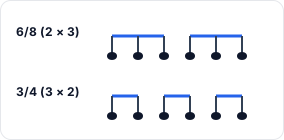
6/8 and 3/4 both hold six eighth notes per measure, but they feel different: 3/4 groups them as three groups of two (simple triple), while 6/8 groups them as two groups of three (compound duple). Beaming is how that grouping is shown.
What is a tuplet?
A tuplet is a group of notes squeezed into a time span that wouldn't normally hold that many — like fitting three notes where only two belong. A tuplet is a group of notes squeezed into a span that would not normally hold that many. The most common is the triplet: three eighth notes played in the time of a quarter note (which normally holds only two eighths). Quintuplets, sextuplets, and so on work the same way.
See Basic Concepts to review how notes are written on the staff.
Frequently asked questions
What does a 4/4 time signature mean? Four beats per measure, each beat a quarter note. It's the most common time signature, also called common time.
What's the difference between a tie and a slur? A tie joins two notes of the same pitch into one longer duration, while a slur connects notes of different pitches to be played smoothly.
Why do 6/8 and 3/4 feel different if they both hold six eighth notes? Because the grouping differs: 3/4 is simple triple (three groups of two), while 6/8 is compound duple (two groups of three).