
Mode Mixture
Updated: 2026-07-04Mode mixture is borrowing chords from the parallel minor during a passage in a major key — which is why it's also called using borrowed chords. It brings a sudden "darker" color into a bright context.
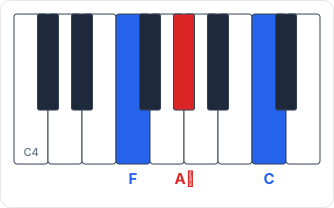
Key takeaways
- Mode mixture borrows chords from the parallel minor during a major-key passage.
- Borrowed chords appear because of lowered scale degrees: ♭6 is the most common, plus ♭3 and ♭7.
- The iv (minor subdominant) and ♭VI are the most common borrowed chords.
- ♭VI deceptive cadence: V → ♭VI instead of V → vi; the Picardy third ends a minor-key piece on a major tonic.
Why do borrowed chords appear?
They come from lowered scale degrees of the parallel minor slipping in. ♭6 is the most common, but ♭3 and ♭7 occur too. These lowered chromatic notes create the characteristic effect.
What are the common borrowed chords?
They're chords carrying lowered scale degrees, borrowed from C minor into C major. The table below is verified with tonal:
| Borrowed chord | Symbol | Notes |
|---|---|---|
| i | Cm | C–E♭–G |
| ii° | D° | D–F–A♭ |
| ♭III | E♭ | E♭–G–B♭ |
| iv | Fm | F–A♭–C |
| ♭VI | A♭ | A♭–C–E♭ |
| ♭VII | B♭ | B♭–D–F |
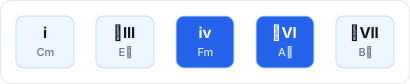
Of these, the iv (minor subdominant) and ♭VI are the most common. A famous example: the opening of R. Strauss's Also Sprach Zarathustra moves straight from major I to minor i.
What are the ♭VI deceptive cadence and the Picardy third?
They're two opposite devices: one brings a darker color into a major key, the other a brighter color into a minor key.
- Deceptive cadence with ♭VI: instead of the diatonic V → vi, you can move V → ♭VI (a borrowed chord) — a deceptive cadence with a chromatic color.
- Picardy third: the reverse device — ending a piece in a minor key on a major tonic chord (raising the third of the i chord), for a surprisingly bright, complete finish.
See Minor Scales & Key Signatures for the parallel minor, and The Neapolitan Chord and Augmented Sixth Chords for other chromatic pre-dominant chords.
Frequently asked questions
Where are borrowed chords borrowed from? From the parallel minor — for example, from C minor while you're in C major. The minor mode's lowered scale degrees (♭6, ♭3, ♭7) bring a darker color into the major passage.
Which lowered scale degree is most common in mode mixture? ♭6 is the most common, with ♭3 and ♭7 also appearing. That's why iv (the minor subdominant) and ♭VI — both containing ♭6 — are the most common borrowed chords.
What is the Picardy third? It's the device of ending a minor-key piece on a major tonic chord (raising the third of the i chord), for a surprisingly bright, complete finish.