Enharmonic Modulation
Updated: 2026-07-04Pivot-chord modulation usually takes us to closely related keys. To jump to distant keys we use enharmonic modulation — exploiting a chord that can be heard (or spelled) two different ways.
Key takeaways
- Enharmonic modulation exploits a chord that can be heard (or spelled) two ways to jump to a distant key.
- The dominant seventh and the German augmented sixth sound alike because G♭ = F♯ (A♭7 ≡ Ger+6 of C).
- The same chord can be presented as V⁷ of D♭, then resolved as the Ger+6 of C.
- The fully-diminished seventh is symmetric, splitting the octave into four equal parts — giving four resolutions.
What's the idea behind enharmonic modulation?
It's respelling a chord that sounds the same into the new key to bridge there. Some chords sound identical but have different names and functions depending on context. If we write a chord in the old key and then reinterpret (respell) it as a chord in a new key, we get a "pivot" that bridges to the new key — even a very distant one.
Why do V⁷ and the German augmented sixth sound alike?
Because they contain the same piano keys — only one note is spelled differently. The dominant seventh and the German augmented sixth sound exactly alike (verified with tonal):
- A♭7 = A♭–C–E♭–G♭
- Ger+6 (in C) = A♭–C–E♭–F♯
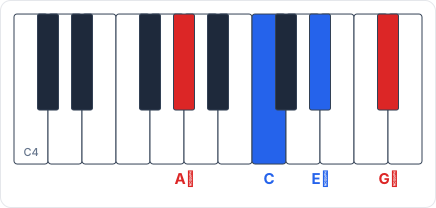
Because G♭ and F♯ are enharmonic, these two chords are identical in sound. A composer can present a chord as V⁷ of D♭, then resolve it as a Ger+6 of C (to the V of C) — one chord opening two completely different harmonic paths.
Why is the fully-diminished seventh the most flexible pivot?
Because its symmetry lets any of its notes be respelled as the root. The fully-diminished seventh (°7) is the most flexible modulating tool because it is symmetric: it is built of equal stacked minor thirds, dividing the octave into four equal parts. As a result, any of its four notes can be respelled as the root, giving four possible resolutions to four different keys.
This symmetry made the diminished seventh a "magic door" of the Romantic era: a single °7 chord can suddenly lead to any of several distant keys.
See Augmented Sixth Chords and Seventh Chords for the chords involved, and Modulation for the fundamentals of changing key.
Frequently asked questions
How does enharmonic modulation differ from ordinary pivot-chord modulation? A pivot chord usually takes you to a closely related key. Enharmonic modulation exploits a chord that can be heard (or spelled) two ways, so it can jump to even very distant keys.
Why do A♭7 and the Ger+6 of C sound identical? Because G♭ (in A♭7) and F♯ (in the Ger+6) are enharmonic — the same piano key. A composer can present the chord as V⁷ of D♭ and then resolve it as the Ger+6 of C.
How many resolutions does one diminished seventh offer? Four — because it's symmetric, any of its four notes can be respelled as the root, leading to four different keys.