Basic Concepts
Updated: 2026-07-04Everything in music theory — scales, chords, harmony — is built on a few basic concepts. Get these first and the rest comes much more easily. This page covers five essentials: pitch, the staff and clefs, note names across octaves, accidentals, and enharmonic notes.
Key takeaways
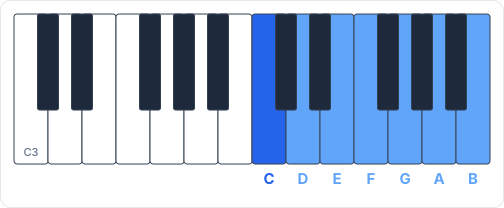
- There are only seven note names — C D E F G A B — repeating across the whole keyboard.
- C4 is "middle C", which is MIDI 60; A4 = 440 Hz.
- The octave number changes after B (B4 is followed by C5), not after C.
- Accidentals raise or lower a pitch; two notes that sound alike but are spelled differently are enharmonic (C♯ = D♭).
What is pitch?
Pitch is how high or low a sound is. A piano has 88 keys: move right and the pitch gets higher, move left and it gets lower. Everything that follows is just a way of naming and organizing those pitches.
How do you read the staff and clefs?
Notes are written on a staff of five lines (and four spaces), and a clef at the start tells you what the lines and spaces are called. The two most common:
- Treble clef: the lines bottom-to-top are E–G–B–D–F; the spaces are F–A–C–E.
- Bass clef: the lines are G–B–D–F–A; the spaces are A–C–E–G.
Piano music is written on a grand staff — treble and bass clefs joined by a brace, with middle C sitting right between them.
How do note names and octaves work?
Music uses only seven note names — C, D, E, F, G, A, B — the musical alphabet. After B the sequence wraps back to C and repeats. Because the names recur across the 88 keys, we add an octave number to pinpoint a note: C4, D4, … C5.
Of these, C4 is "middle C" — the single most important reference point. Under the MIDI standard, C4 = 60 and A4 = 69 (a frequency of 440 Hz); these figures were verified with the tonal library.
Here's an easy thing to trip over: the octave number changes after B, not after C. So the note right after B4 is C5 — not "another C4."
Accidentals
Accidentals are symbols placed before a note to raise or lower its pitch. There are five:
| Accidental | Symbol | Effect |
|---|---|---|
| Sharp | ♯ | Raises the note a half step |
| Flat | ♭ | Lowers the note a half step |
| Double sharp | 𝄪 | Raises the note two half steps (a whole step) |
| Double flat | 𝄫 | Lowers the note two half steps (a whole step) |
| Natural | ♮ | Cancels an earlier accidental in the measure or key signature |
Why are C♯ and D♭ the same key?
Two notes that sound identical but are written with different names are enharmonic. C♯ and D♭ are the same black key on the piano — just spelled differently depending on context.
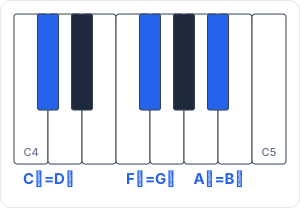
This happens on every black key (C♯=D♭, D♯=E♭, F♯=G♭, G♯=A♭, A♯=B♭), and on white keys too (C=B♯, E=F♭). Which spelling you choose depends on the scale and context — something we return to with major scales and intervals.
Frequently asked questions
Which note is middle C? It's C4 — the C near the middle of the piano keyboard, corresponding to MIDI 60. On the grand staff it sits on a ledger line between the treble and bass clefs.
What's the difference between a sharp and a flat? A sharp (♯) raises a note by a half step; a flat (♭) lowers it by a half step. A natural (♮) cancels them.
How many note names are there in total? Just seven: C, D, E, F, G, A, B. They repeat in every octave, so all 88 piano keys use only these seven names (plus accidentals for the black keys).