Major Scales & Key Signatures
Updated: 2026-07-04The major scale is the foundation of most Western music. Understanding how it is built — and the key signature that goes with it — lets you read, write, and play in any key.
Key takeaways
- The major scale follows a fixed W–W–H–W–W–W–H pattern of whole and half steps.
- A major scale uses all seven letter names in order, with none repeated or skipped.
- There are 15 major key signatures: C with none, plus 7 sharp keys and 7 flat keys.
- The order of sharps is F–C–G–D–A–E–B; the order of flats is its reverse.
- The circle of fifths helps you memorize signatures: each perfect 5th clockwise adds one sharp.
What are half steps and whole steps?
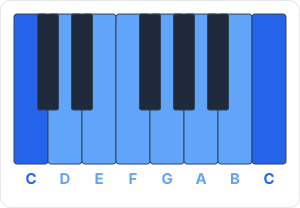
A half step is the smallest distance on the piano, and a whole step equals two half steps — and every scale pattern is described as a chain of these two intervals.
- A half step is the distance from one key to the nearest key beside it on the piano (including black keys).
- A whole step equals two half steps.
Every scale pattern is described using these two intervals.
How is the major scale built?
A major scale follows a fixed pattern of whole steps (W) and half steps (H): W – W – H – W – W – W – H. That's the one formula, and it works for every major key.
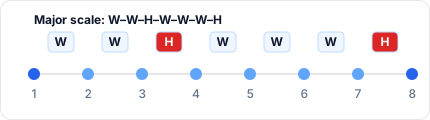
It helps to see this as two identical tetrachords (four-note segments) — W–W–H — joined by a whole step. Expressed as intervals, the major scale is 1P, 2M, 3M, 4P, 5P, 6M, 7M (verified with tonal).
One key rule: a major scale uses all seven letter names in order, with none repeated or skipped. For example, D major is D–E–F♯–G–A–B–C♯ — not D–E–G♭–G–A–B–C♯, which would repeat G and skip F.
What's in a major key signature?
A key signature is the set of sharps or flats placed at the start of the staff to declare them for the whole key — there are 15 major key signatures in all. Rather than writing an accidental before every note, we place a key signature at the start of the staff to declare the sharps or flats of the key. There are 15 major key signatures: C major with none, plus 7 sharp keys and 7 flat keys.
| Accidentals | Sharp key | Flat key |
|---|---|---|
| 0 | C | — |
| 1 | G | F |
| 2 | D | B♭ |
| 3 | A | E♭ |
| 4 | E | A♭ |
| 5 | B | D♭ |
| 6 | F♯ | G♭ |
| 7 | C♯ | C♭ |
The order of sharps is always F – C – G – D – A – E – B (mnemonic: "Father Charles Goes Down And Ends Battle"). The order of flats is the reverse: B – E – A – D – G – C – F.
Quick ways to name a major key from its signature:
• Sharp key signatures: go up a half step from the last sharp (e.g. last sharp is F♯ → G major).
• Flat key signatures: the second-to-last flat is the key (e.g. flats B♭ E♭ A♭ → A♭ major).
How does the circle of fifths help?
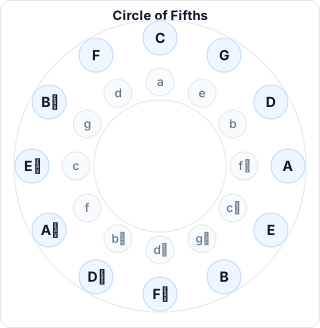
The circle of fifths arranges every key by perfect 5ths, giving you the most intuitive way to memorize signatures. Arranging the keys around the circle of fifths is the most intuitive way to memorize signatures: each step up a perfect 5th (clockwise) adds one sharp, and each step down a perfect 5th (counter-clockwise) adds one flat.
At the bottom of the circle, a few keys are enharmonic: B (5♯) = C♭ (7♭), F♯ (6♯) = G♭ (6♭), C♯ (7♯) = D♭ (5♭).
See Intervals for what "perfect 5th" means, and Minor Scales & Key Signatures for the matching minor keys.
Frequently asked questions
What's the major scale pattern? It's W – W – H – W – W – W – H (whole and half steps). The same pattern builds a major scale in any key.
How many major key signatures are there? There are 15: C major with none, plus 7 sharp keys and 7 flat keys.
How do I name a major key from a flat key signature? The second-to-last flat is the key — for example, flats B♭ E♭ A♭ give you A♭ major.