
Intervals
Updated: 2026-07-04An interval is the distance in pitch between two notes. It is the basic unit for describing melody and harmony: scales, chords, and even complex harmonic progressions are all built from intervals.
Key takeaways
- Every interval needs two things: a number (count the note names) and a quality (perfect/major/minor/augmented/diminished).
- Unisons, 4ths, 5ths, and octaves are only perfect; 2nds, 3rds, 6ths, and 7ths come in major and minor forms.
- To invert an interval: the numbers add up to 9, and the quality flips (major ↔ minor, augmented ↔ diminished, perfect stays perfect).
- The tritone (6 half steps) is the augmented 4th = diminished 5th, splitting the octave in half.
- Spelling decides an interval's name, not just the sound.
What makes up an interval?
An interval's name combines two things: a number (how many note names it spans) and a quality (perfect, major, minor, augmented, or diminished). Every interval is named by combining two pieces of information:
- Number — count the note names from the lower to the higher note, including both ends. From C to E is C–D–E → a 3rd.
- Quality — perfect (P), major (M), minor (m), augmented (A), or diminished (d). The quality tells you exactly how many half steps the interval spans.
The number alone is not enough: C–E and C–E♭ are both "3rds," but one is a major 3rd (4 half steps) and the other a minor 3rd (3 half steps). Always determine both the number and the quality.
Which intervals fit within an octave?
There are thirteen basic intervals within an octave, from the perfect unison (0 half steps) up to the perfect octave (12 half steps). The table below lists every basic interval within an octave, with its half-step count and an example built from C. The numbers have been verified with the tonal library.
| Interval | Symbol | Half steps | Example from C |
|---|---|---|---|
| Perfect unison | 1P | 0 | C–C |
| Minor 2nd | 2m | 1 | C–D♭ |
| Major 2nd | 2M | 2 | C–D |
| Minor 3rd | 3m | 3 | C–E♭ |
| Major 3rd | 3M | 4 | C–E |
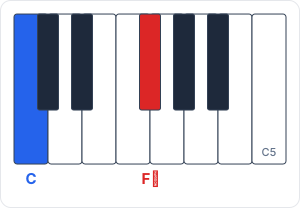
| Perfect 4th | 4P | 5 | C–F |
| Augmented 4th / diminished 5th (tritone) | 4A / 5d | 6 | C–F♯ / C–G♭ |
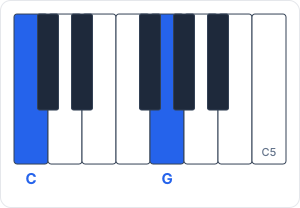
| Perfect 5th | 5P | 7 | C–G |
| Minor 6th | 6m | 8 | C–A♭ |
| Major 6th | 6M | 9 | C–A |
| Minor 7th | 7m | 10 | C–B♭ |
| Major 7th | 7M | 11 | C–B |
| Perfect octave | 8P | 12 | C–C |
Unisons, 4ths, 5ths, and octaves come only in a perfect form (there is no "major"/"minor" version). 2nds, 3rds, 6ths, and 7ths come in both major and minor forms — the minor form is one half step smaller than the major.
What does inverting an interval mean?
Inverting an interval means moving the lower note up an octave (or the upper note down one), swapping which note sits on the bottom. To invert an interval, move the lower note up an octave (or the upper note down an octave). Two rules let you check your work quickly:
- The numbers add up to 9. A 2nd inverts to a 7th, a 3rd to a 6th, a 4th to a 5th.
- The quality flips: major ↔ minor, augmented ↔ diminished, while perfect stays perfect.
For example, a major 3rd (C–E) inverts to a minor 6th (E–C); the half-step totals of an interval and its inversion always add up to 12.
Because the augmented 4th and diminished 5th are both 6 half steps and invert to each other, they sound identical on a keyboard — this is the tritone, the interval that splits the octave exactly in half.
What are augmented and diminished intervals?
An augmented interval is one half step wider than the perfect or major form, and a diminished interval is one half step narrower than the perfect or minor form.
- Augmented (A): one half step wider than a perfect or major interval (e.g. C–F♯ is an augmented 4th).
- Diminished (d): one half step narrower than a perfect or minor interval (e.g. C–G♭ is a diminished 5th).
Two notes that sound the same but are spelled differently produce different interval names — the spelling determines the name, not just the sound.
Quick identification tips
- Count note names first to get the number.
- Count the half steps, then check the table above to get the quality.
- For ear training, pair each interval with a familiar tune — a perfect 5th, for instance, is the first two notes of "Twinkle, Twinkle, Little Star."
Frequently asked questions
What do you need to name an interval? You need two things: the number (count note names from the lower to the higher note, including both ends) and the quality (perfect, major, minor, augmented, or diminished).
What is the tritone? It's the 6-half-step interval — the augmented 4th (C–F♯) and diminished 5th (C–G♭) are the same sound, splitting the octave in half and inverting to each other.
How do the numbers change when you invert an interval? An interval and its inversion always add up to 9 (a 3rd inverts to a 6th), and the quality flips: major ↔ minor, augmented ↔ diminished, while perfect stays perfect.