
Secondary Diminished Chords
Updated: 2026-07-04The vii° chord has dominant function (like V), so alongside the secondary dominant we can also tonicize with a secondary diminished chord — a chord built on the target's leading tone.
Key takeaways
- A secondary diminished chord is built on the leading tone of a chord other than I, resolving to that chord.
- The leading tone lies a half step (minor 2nd) below the target's root.
- A minor target → use a fully-diminished seventh (vii°7); a major target → usually half-diminished (viiø7).
- Notation: vii°/x, viiø⁷/x, vii°⁷/x — the Roman numeral after the slash is the tonicized chord.
What is a secondary diminished chord?
It's a diminished chord built on the leading tone of a chord other than I, resolving to that chord. A secondary diminished chord is a diminished triad (vii°), half-diminished seventh (viiø7), or fully-diminished seventh (vii°7) built on the leading tone of a chord other than I, resolving to that chord. The leading tone lies a half step (minor 2nd) below the target's root. Notation: vii°/x, viiø⁷/x, vii°⁷/x — the Roman numeral after the slash is the tonicized chord.
Major keys: half-diminished vs. fully-diminished?
The answer depends on the target chord's quality. By traditional practice:
- A minor target chord → use a fully-diminished seventh (vii°7).
- A major target chord → traditionally use a half-diminished seventh (viiø7), though fully-diminished is also acceptable.
The table below is in C major (verified with tonal):
| Target | Quality | Secondary diminished | Built on |
|---|---|---|---|
| ii (Dm) | minor | vii°⁷/ii = C♯°7 | C♯ |
| iii (Em) | minor | vii°⁷/iii = D♯°7 | D♯ |
| IV (F) | major | viiø⁷/IV = Eø7 | E |
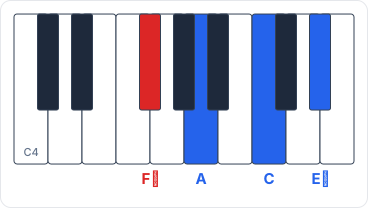
| V (G) | major | viiø⁷/V = F♯ø7 | F♯ |
| vi (Am) | minor | vii°⁷/vi = G♯°7 | G♯ |
How do you analyze and write a secondary diminished chord?
Both hinge on the half-step relationship between the leading tone and the target's root. A secondary diminished chord resolves up a half step to its target, just as vii°7/V resolves to V and then continues to I.
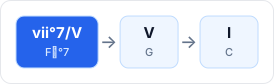
- Analysis: when you meet a chord with a chromatic note, stack it in thirds. If it is a diminished triad / half-diminished / fully-diminished seventh, find the note a half step above its root — if that note is the root of a diatonic chord, this is a secondary diminished chord heading to it.
- Writing: find the root of the target chord (right of the slash), take its leading tone (m2 below), build the appropriate diminished chord, and invert per the figured bass.
See Seventh Chords for ø7 and °7 chords, and Secondary Dominants for the parallel way to tonicize.
Frequently asked questions
What note is a secondary diminished chord built on? On the leading tone of the target chord — the note a half step (minor 2nd) below the target's root. That note then resolves up a half step to the target.
When do I use vii°7 (fully-diminished) versus viiø7 (half-diminished)? Use a fully-diminished seventh (vii°7) for a minor target; for a major target you usually use a half-diminished seventh (viiø7), though fully-diminished is also acceptable.
How does it differ from a secondary dominant? Both tonicize a chord other than I, but a secondary dominant is a dominant chord (major/dominant-seventh) while a secondary diminished is a diminished chord built on the leading tone.