Accompanimental Textures
Updated: 2026-07-04The same chord progression can be accompanied in countless ways, and that choice of texture supplies much of a piece's character. This page surveys the common accompanimental textures.
Key takeaways
- The same chord progression can be accompanied in countless ways, and that texture choice supplies much of a piece's character.
- Three basic textures: monophonic, homophonic (the most common in pop/classical), and polyphonic.
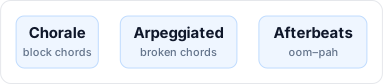
- Common accompaniment patterns: chorale, arpeggiation (the Alberti bass), and block-chord.
- Afterbeats (Schoenberg's term) are chords that answer after the downbeat — the "oom-pah" pattern; accents on weak beats are offbeats.
- Distinctive bass lines (like a walking bass) and the 3–2 clave act as the rhythmic backbone of many songs.
What is texture?
Texture describes how many layers of sound there are and how they relate. Three basic types:
- Monophonic: a single melodic line with no accompaniment.
- Homophonic: one main melody plus chordal accompaniment — the most common texture in pop and classical music.
- Polyphonic: several independent melodic lines sounding together (see Introduction to Counterpoint).
What are the common accompaniment patterns?
These three sort accompaniments by how a chord's notes are spread out in time — struck together, one at a time, or in a pattern:
| Pattern | Description |
|---|---|
| Chorale texture | Block chords, roughly one per melody note — like a four-part hymn |
| Arpeggiation | The chord's notes played one at a time (broken chords); the Alberti bass is the classic example |
| Block-chord | The full chord struck together, often as repeated eighth or quarter notes |
What are afterbeats and offbeats?
Afterbeats are chords that answer after the downbeat, while offbeats are accents that land on the weak beats. Afterbeats (a term from composer Arnold Schoenberg) are repeated chords that sound after the downbeat: the bass plays the downbeat while the chords "answer" on the weak beats — the familiar "oom-pah" accompaniment. When accents fall on the weak beats or weak parts of beats, we call it offbeat (syncopated) — a hallmark of many popular styles.
How do bass lines and clave shape the accompaniment?
They supply the rhythmic and low-register backbone that the other layers lean on.
- Distinctive bass lines: an accompaniment is often shaped by a characteristic bass pattern — for example a walking bass (a stepwise note-per-beat line) in jazz, or a repeating ostinato.
- 3–2 clave: a two-measure rhythmic pattern from Latin/Afro-Cuban music — three strokes in the first bar, two in the second — that serves as the rhythmic backbone of many songs.
See Harmonic Progression & Function for the chords being accompanied, and Creating Contrast Between Sections for how changing texture distinguishes sections.
Frequently asked questions
How is homophonic texture different from polyphonic? Homophonic texture has one main melody plus chordal accompaniment, while polyphonic texture has several independent melodic lines sounding together.
What is an Alberti bass? It's the classic arpeggiation pattern: the chord's notes are played one at a time (as broken chords) instead of struck together.
What does "afterbeat" mean? Afterbeats are repeated chords that sound after the downbeat (the bass plays the downbeat, the chords answer on the weak beats) — the familiar "oom-pah" accompaniment; the term comes from Arnold Schoenberg.