
Secondary Dominants
Updated: 2026-07-04So far every chord has stayed within the key signature (diatonic). Chromatic harmony begins when we borrow notes from outside the key — and the most common way in is the secondary dominant.
Key takeaways
- Tonicization treats a chord other than I as a temporary tonic by preceding it with its own dominant.
- A secondary dominant is a major triad or dominant seventh that resolves to a chord other than I (any diatonic chord except vii°).
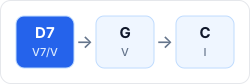
- In C major, for example, V⁷/V = D7 resolves to G.
- The Roman numeral after the slash is the tonicized chord; label D7 as V⁷/V, not "II⁷."
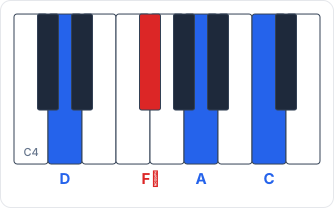
- The tell-tale sign is a note outside the key (like F♯ in C major).
What is tonicization?
It's treating a chord other than I as a temporary tonic by preceding it with its own dominant. Tonicization: in diatonic harmony, V (dominant) resolves to I (tonic); if we want to emphasize the V chord, we can precede it with the dominant of G — momentarily making G feel like a "tonic."
What is a secondary dominant?
It's a major triad or dominant seventh chord that resolves to a chord other than I. A secondary dominant works this way because a dominant sits a perfect 5th above its target, so every diatonic chord (except vii°) has its own secondary dominant. The table below is in C major, verified with tonal:
| Symbol | Chord | Resolves to |
|---|---|---|
| V⁷/V | D7 | G (V) |
| V⁷/ii | A7 | Dm (ii) |
| V⁷/iii | B7 | Em (iii) |
| V⁷/IV | C7 | F (IV) |
| V⁷/vi | E7 | Am (vi) |
How do you label and analyze a secondary dominant?
The whole thing comes down to one rule: the Roman numeral after the slash is the chord being tonicized. The Roman numeral after the slash is the chord being tonicized by the dominant before the slash. We read "V⁷/V" as "V of V."
- D7 in C major should be labeled V⁷/V, not "II⁷" — because V⁷/V shows its function (driving to G), while "II⁷" states only the root and hides the function.
- The vii° chord is usually not tonicized (a diminished chord makes a poor temporary "tonic").
The tell-tale sign of a secondary dominant is a note outside the key (a chromatic note), usually the leading tone of the target — e.g. F♯ in C major signals a chord heading toward G.
See Seventh Chords for the dominant seventh, and Secondary Diminished Chords for tonicizing with a diminished chord.
Frequently asked questions
Why label D7 in C major as V⁷/V rather than "II⁷"? Because V⁷/V shows the chord's function — it drives to G (V). The label "II⁷" states only the root and hides the secondary-dominant function.
How do I spot a secondary dominant when analyzing? Look for a note outside the key (a chromatic note), usually the leading tone of the target chord. For example, F♯ in C major signals a chord heading toward G.
Does every diatonic chord have its own secondary dominant? Almost — every diatonic chord does except vii°, since a diminished chord makes a poor temporary "tonic."