Voice Leading Triads
Updated: 2026-07-04Voice leading is the art of connecting chords so that each individual voice moves smoothly. The tradition uses four voices, SATB: Soprano, Alto, Tenor, and Bass.
Key takeaways
- Voice leading uses four voices, SATB (Soprano, Alto, Tenor, Bass), each moving independently.
- There are four types of motion: contrary, oblique, similar, and parallel.
- Rule number one: avoid parallel perfect fifths and parallel octaves.
- Keep voices in range, don't let them cross, and keep adjacent upper voices within an octave.
- Double the root in root position; never double the leading tone.
What are the types of motion?
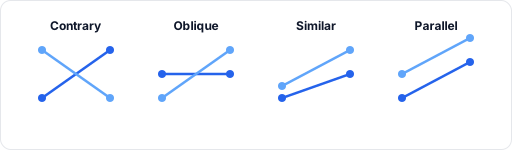
There are four: contrary, oblique, similar, and parallel. When comparing any two voices, the motion between them is one of these four types:
| Type | Description |
|---|---|
| Contrary | The two voices move in opposite directions |
| Oblique | One voice stays, the other moves |
| Similar | Same direction, but the interval between them changes |
| Parallel | Same direction and the interval stays the same |
Why avoid parallels?
Because they strip two voices of their independence and fuse them together. The single most important rule: avoid parallel perfect fifths and parallel octaves between any two voices. They fuse two voices together and destroy the independence of the four parts — this is the most common mistake to avoid.
How do you handle ranges and spacing?
Keep each voice in its comfortable range, don't let voices cross, and don't spread the upper voices too far apart.
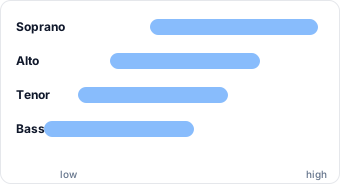
- Ranges: each voice has its own range; keep each voice in its comfortable range and don't let voices cross (an upper voice dropping below a lower one).
- Spacing: between adjacent upper voices (Soprano–Alto and Alto–Tenor), stay within an octave. Tenor and Bass may be spaced farther apart.
Which note should you double?
It depends on the inversion: in root position double the root, in second inversion double the fifth, and never double the leading tone. Because there are four voices but a triad has only three notes, one note must be doubled:
- Root position: usually double the root.
- Second inversion (⁶⁴): usually double the fifth (the bass note).
- Never double the leading tone (the raised 7th), since two leading tones would be forced to resolve into parallel octaves.
The general rule for connecting two chords: keep the common tone in the same voice, and move the other voices to the nearest chord tone by step — favoring contrary motion with the bass.
See Triads for inversions, and Voice Leading Seventh Chords for the next step.
Frequently asked questions
Why can't you double the leading tone? Two leading tones both tend to resolve up to the tonic, so resolving both would create parallel octaves — exactly the mistake voice leading tries to avoid.
What's the difference between similar and parallel motion? Both move in the same direction, but similar motion changes the interval between the voices, while parallel motion keeps it the same — and it's parallel perfect fifths or octaves that are forbidden.
What's the smoothest way to connect two chords? Keep the common tone in the same voice, then move the remaining voices to the nearest chord tone by step, favoring contrary motion with the bass.