Minor Scales & Key Signatures
Updated: 2026-07-04If the major scale sounds "bright," minor scales usually sound darker or more melancholic. The difference comes from a few lowered scale degrees — and in minor we actually have three forms of the scale.
Key takeaways
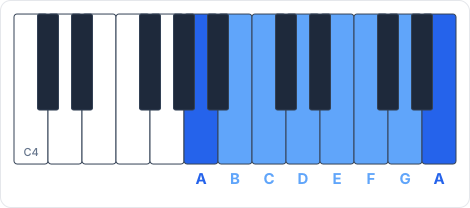
- Minor has three forms: natural, harmonic, and melodic, differing in their 6th and 7th.
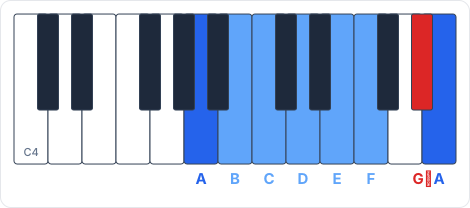
- Compared to the parallel major, minor lowers the 3rd, 6th, and 7th; harmonic minor raises the 7th back (A→G♯ in A minor).
- A minor key signature matches its natural minor scale — three flats more than its parallel major.
- Parallel keys share a tonic but differ in signature; relative keys share a signature but differ in tonic.
- Each degree has a name (tonic, dominant…); the 7th is the leading tone or subtonic depending on its distance to the tonic.
How do the three minor scales differ?
Minor lowers the 3rd, 6th, and 7th relative to the parallel major, and comes in three forms distinguished by their 6th and 7th. Compared to the major scale on the same tonic (the parallel major), minor lowers the 3rd, 6th, and 7th degrees. The three forms differ in their 6th and 7th:
- Natural minor: lower degrees 3, 6, and 7. Example, A minor: A–B–C–D–E–F–G.
- Harmonic minor: like natural minor but with the 7th raised back up. A harmonic minor: A–B–C–D–E–F–G♯.
- Melodic minor: ascending, raise both the 6th and 7th; descending, it is identical to natural minor. A melodic minor (ascending): A–B–C–D–E–F♯–G♯.
These notes were verified with tonal. In practice, a piece in minor rarely uses one form "purely" — composers mix all three as the melody and harmony demand. The three scales are just a way of systematizing that practice.
How do minor key signatures work?
A minor key's signature matches its natural minor scale, which puts it three flats "darker" than its parallel major. A minor key's signature matches its natural minor scale. Because C natural minor contains E♭, A♭, and B♭, the key signature of C minor has three flats.
Relative to the parallel major (same tonic), a minor key signature is always three degrees "darker" — equivalent to adding three flats (or subtracting three sharps). For example: C major (no accidentals) → C minor (three flats).
When you write the harmonic or melodic form while using the minor key signature, you must add extra accidentals to raise the 7th (and 6th) — they are not in the signature.
Parallel vs. relative
These two relationships are easy to confuse:
- Parallel keys: same tonic, different signature. C major ↔ C minor.
- Relative keys: same signature, different tonic. C minor and E♭ major both have three flats, so they are relatives. The relative major sits three half steps above the relative minor (C minor → E♭ major). Likewise, A minor and C major both have no accidentals.
Scale-degree names
Besides numbers, each scale degree has a name — used throughout the study of chords and harmony:
| Degree | Name |
|---|---|
| 1 | Tonic |
| 2 | Supertonic |
| 3 | Mediant |
| 4 | Subdominant |
| 5 | Dominant |
| 6 | Submediant |
| 7 | Leading tone / Subtonic |
The 7th degree has two names depending on its distance to the tonic: leading tone when a half step below the tonic (like the raised 7th in harmonic minor), and subtonic when a whole step below (like the 7th in natural minor).
See Major Scales & Key Signatures for comparison, and Intervals for "half step / whole step."
Frequently asked questions
How many forms of the minor scale are there? Three: natural minor (♭3, ♭6, ♭7), harmonic minor (natural minor with a raised 7th), and melodic minor (raises the 6th and 7th ascending, and descends like natural minor).
What's the difference between parallel and relative minor? A parallel minor shares the same tonic (C major ↔ C minor); a relative minor shares the same key signature (C minor and E♭ major both have three flats).
How many flats are in C minor? Three — E♭, A♭, and B♭ — because a minor key's signature matches its natural minor scale.