
Binary & Ternary Forms
Updated: 2026-07-04Two foundational forms in classical music are binary form and ternary form. They describe how many large parts a piece divides into and how those parts relate.
Key takeaways
- Binary form has two parts, A and B, each usually repeated.
- Ternary form is A – B – A: a contrasting B and a full return of A (often da capo).
- Classify binary by how A ends: sectional (closed, PAC) or continuous (open, ends on V).
- Rounded binary brings back only part of A, in the scheme ‖: A :‖: B A′ :‖.
- The key difference: in ternary each section is self-standing; in rounded binary it isn't.
What is binary form?
Binary form has two parts, A and B, each usually repeated, and we classify it by how the A section ends.
Binary form has two parts (A and B), each usually repeated. We classify it by how the A section ends:
- Sectional binary: the A section is harmonically closed — it ends on the tonic (PAC).
- Continuous binary: the A section is harmonically open — it ends on V or modulates, pushing on to B.
In addition:
- Rounded binary: at the end of B, the material of A returns — the scheme ‖: A :‖: B A′ :‖.
- Simple binary: A does not return.
- Balanced binary: the end of A and the end of B use similar cadential material.
How is ternary form different?
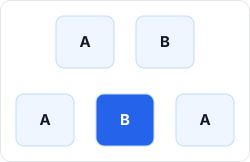
Ternary form is A – B – A, where B is an independent contrasting part and A returns in full.
Ternary form has three parts A – B – A: the B section is an independent, contrasting part, and the A section returns in full (often marked da capo).
How do you tell ternary from rounded binary?
Ask whether each section can stand on its own: in ternary it can, in rounded binary it can't. Both feature a "return" of A, so they're easy to confuse. The key difference:
- In ternary form, each A and B section is a complete, self-standing unit (the A section ends conclusively).
- In rounded binary, the parts are not self-standing (the A section often ends open) and are bound by repeat signs; only part of A returns.
See Phrases in Combination for the smaller phrase level, and Sonata & Rondo Forms for larger forms.
Frequently asked questions
Is rounded binary just ternary form? No. Although both bring A back, rounded binary returns only part of A and its parts aren't self-standing (the A section often ends open), whereas ternary has complete sections and a full return of A.
What's the difference between sectional and continuous binary? It's how the A section ends: sectional binary closes harmonically (it stops on the tonic, a PAC), while continuous binary ends open (on V or in a new key), pushing on to B.
What does "da capo" mean in ternary form? It tells the performer to go back to the beginning and repeat the whole A section after B — exactly the "A returns in full" that defines ternary form.