
Augmented Sixth Chords
Updated: 2026-07-04Augmented sixth chords are a family of chromatic pre-dominant chords named after countries — Italian, French, German — defined by a characteristic interval: the augmented sixth.
Key takeaways
- Augmented sixth chords are chromatic pre-dominant chords defined by an augmented sixth between ♭6 and ♯4.
- Those two notes resolve outward — ♭6 down, ♯4 up — both landing on scale degree 5 (the root of V).
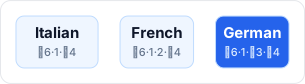
- Three types: Italian (♭6,1,♯4), French (♭6,1,2,♯4), German (♭6,1,♭3,♯4).
- The German sounds identical to a dominant seventh (A♭7), which is the key to enharmonic modulation.
What is the augmented sixth?
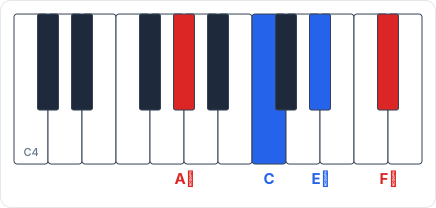
It's the characteristic interval between ♭6 and ♯4 that defines all three chords. What all three share is an augmented sixth interval between scale degree ♭6 (in the bass) and ♯4. In C that is A♭ → F♯ (an augmented 6th = 10 semitones, verified with tonal). These two notes resolve outward: ♭6 down and ♯4 up, both arriving on scale degree 5 (the root of the V chord).
How do the three augmented sixth chords differ?
All three contain ♭6 and ♯4 and differ only in the note(s) in between. The table below is in C:
| Type | Structure | Notes (in C) |
|---|---|---|
| Italian (It+6) | ♭6, 1, ♯4 | A♭, C, F♯ |
| French (Fr+6) | ♭6, 1, 2, ♯4 | A♭, C, D, F♯ |
| German (Ger+6) | ♭6, 1, ♭3, ♯4 | A♭, C, E♭, F♯ |
How do augmented sixth chords resolve?
They have pre-dominant function, so they head toward the dominant harmony. Augmented sixth chords have pre-dominant function and usually resolve to V. The German (Ger+6) in particular creates parallel fifths if it moves straight to V, so it typically passes through a cadential six-four (I⁶⁴) first.
The German augmented sixth (A♭–C–E♭–F♯) sounds identical to a dominant seventh chord (A♭7), because F♯ is enharmonic with G♭. This enharmonic equivalence is the key to enharmonic modulation.
The bass in augmented-sixth passages often descends chromatically, linking a chain of chromatic pre-dominant chords.
See Mode Mixture and The Neapolitan Chord for other chromatic pre-dominant chords.
Frequently asked questions
What defines an augmented sixth chord? The augmented sixth interval between scale degree ♭6 (in the bass) and ♯4. In C that's A♭ → F♯ (10 semitones); those two notes resolve outward to scale degree 5.
How do the Italian, French, and German types differ? All three share ♭6 and ♯4; the difference is the note in between: the Italian adds scale degree 1, the French adds 1 and 2, and the German adds 1 and ♭3.
Why does the Ger+6 usually pass through a cadential six-four before V? Because moving the German straight to V creates parallel fifths, so it typically passes through I⁶⁴ first.