Modulation
Updated: 2026-07-04Modulation is a genuine change of key within a piece — as opposed to merely visiting a chord for a moment.
Key takeaways
- Modulation is a genuine, lasting change of key, usually confirmed by a cadence in the new key.
- It contrasts with tonicization — emphasizing a chord other than I only momentarily before returning.
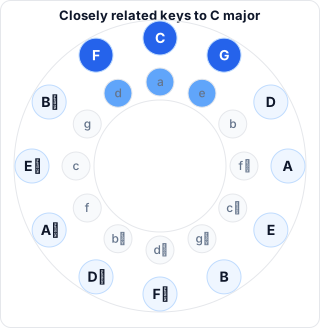
- A closely related key differs from the original by at most one accidental; for C major that's G, F, Am, Em, Dm.
- A pivot chord is common to both keys and gets reinterpreted to bridge smoothly between them.
How does modulation differ from tonicization?
The difference is how firmly the change sticks: modulation establishes a new key, while tonicization is just a passing emphasis.
- Tonicization (see secondary dominants): emphasizing a chord other than I momentarily, then returning to the original key — not enough to count as a change of key.
- Modulation: the new key is firmly established, usually confirmed by a cadence in the new key. It is a lasting change, not a passing one.
The line between the two is a matter of degree: whether the new key is confirmed by a cadence and sustained long enough.
Which keys are easiest to modulate to?
The easiest are closely related keys — ones that differ from the original by at most one accidental. The easiest modulation is to a closely related key — one whose key signature differs from the original by at most one accidental. For C major, the five closely related keys are:
| Closely related key | Relationship |
|---|---|
| G major | Dominant (one more sharp) |
| F major | Subdominant (one more flat) |
| A minor | Relative minor of C |
| E minor | Relative minor of G |
| D minor | Relative minor of F |
These are the keys adjacent on the circle of fifths together with their relative minors.
How does a pivot chord modulate?
It's a chord common to both keys that gets reinterpreted to bridge between them. The smoothest way to modulate is with a pivot chord — a chord common to both keys that is reinterpreted: it is one scale degree in the old key and a different one in the new key. After the pivot, the music moves straight to the dominant of the new key and cadences there.

- Diatonic pivot: the shared chord belongs naturally to both keys.
- Chromatic pivot: a chromatic chord (e.g. a borrowed chord or secondary dominant) serves as the bridge.
- Modulation without a pivot: a direct (phrase) modulation, often at the boundary between two sections.
How do you recognize a modulation?
Watch for a new leading tone that keeps recurring together with a cadence in the new key. The clearest sign of a modulation is the regular appearance of a new leading tone (a new chromatic note) and a cadence in the new key. When the same chromatic note keeps recurring and the harmony revolves around a new center, it is a modulation — no longer just tonicization.
See Secondary Dominants for the contrast with tonicization, and Enharmonic Modulation for reaching distant keys.
Frequently asked questions
How is modulation different from tonicization? Modulation firmly establishes a new key and sustains it long enough, usually confirmed by a cadence in the new key. Tonicization just emphasizes a chord momentarily before returning to the original key.
For C major, what are the five closely related keys? G major, F major, A minor, E minor, and D minor — the keys whose signatures differ from C major by at most one accidental.
What's the difference between a diatonic pivot and a chromatic pivot? A diatonic pivot belongs naturally to both keys; a chromatic pivot uses a chromatic chord (like a borrowed chord or secondary dominant) as the bridge.