
Sonata & Rondo Forms
Updated: 2026-07-04On a larger scale than binary and ternary forms, classical music has two important forms: sonata and rondo.
Key takeaways
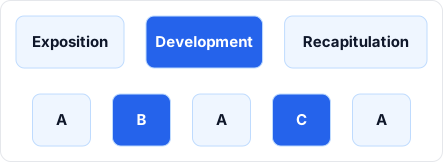
- Sonata form has three parts: exposition – development – recapitulation.
- In the exposition, theme 2 is in a contrasting key; in the recapitulation it returns in the tonic.
- That's a "departure and return" of key at the level of the whole movement.
- Rondo form is built on an A theme that keeps returning (always in the tonic), alternating with contrasting episodes.
- Rondo schemes: five-part A–B–A–C–A, and seven-part / sonata-rondo A–B–A–C–A–B–A.
How does sonata form work?
Sonata form is a three-part frame — exposition, development, recapitulation — that shapes countless Classical-era first movements.
Sonata form is the structure of countless first movements from the Classical era, with three main parts:
- Exposition: introduces theme 1 in the tonic key, a transition, then theme 2 in a contrasting key (usually the dominant or relative major), closing with a closing theme.
- Development: fragments, transforms, and modulates the themes — the most unstable and dramatic part.
- Recapitulation: the themes return, but now theme 2 is in the tonic, resolving the earlier key tension.
Many works add an introduction and a coda. Broadly, these parts fulfill structural functions: stating the ideas, developing them, then recapitulating them — a "departure and return" at the level of the whole movement.
How is rondo form built?
Rondo takes a refrain theme, A, that keeps returning in the tonic, alternating with contrasting episodes.
Rondo form is based on a rondo theme (refrain, A) that keeps returning, alternating with contrasting episodes:
- Five-part rondo: A – B – A – C – A
- Seven-part / sonata-rondo: A – B – A – C – A – B – A
The rondo theme always returns in the tonic each time. In character, rondos are typically lively and playful, which is why they are often used as the final movement of a sonata or symphony.
See Binary & Ternary Forms for smaller forms, and Melodic Analysis for how themes are developed.
Frequently asked questions
What's the biggest difference between the exposition and the recapitulation? It's the key of theme 2: in the exposition it's in a contrasting key (usually the dominant or relative major), while in the recapitulation it returns in the tonic, which resolves the key tension.
How does a rondo differ from a sonata-rondo? A five-part rondo follows A–B–A–C–A, while a sonata-rondo (seven-part rondo) is A–B–A–C–A–B–A — the contrasting B returns near the end, blending the rondo's repetition with sonata form's key balance.
Why is rondo so often used as a final movement? Its lively, playful character and catchy, recurring theme make it a light, upbeat close for a sonata or symphony.