
Figured Bass
Updated: 2026-07-04In earlier chapters we borrowed slash-chord notation to show inversions (I/3rd). From here on we use figured bass — the standard system of small numbers placed after the Roman numeral.
Key takeaways
- Figured bass is small numbers placed after the Roman numeral to show inversion.
- The numbers give the reduced intervals from the bass up to the notes above; for sevenths the "7" is dropped once inverted (write I⁶⁵, not I⁷⁶⁵).
- The cadential six-four (I⁶⁴) sits right before V and actually has dominant function.
- A second-inversion (⁶⁴) chord appears in only four situations: cadential, passing, pedal, and melodic bass.
How do figured-bass inversion symbols work?
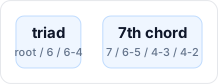
The numbers give the (reduced) intervals from the bass note up to the notes above it. For seventh chords, the "7" is dropped once the chord is inverted (write I⁶⁵, not I⁷⁶⁵).
| Inversion | Triad | Seventh chord |
|---|---|---|
| Root position | (none) | 7 |
| First inversion (3rd in bass) | 6 | 6/5 |
| Second inversion (5th in bass) | 6/4 | 4/3 |
| Third inversion (7th in bass) | — | 4/2 (or 2) |
For example, I⁶ is a I chord in first inversion; V⁶⁵ is a V7 chord in first inversion. Quality symbols like M (major seventh), °, and ø go before the figured-bass numbers and after the Roman numeral.
What is the cadential six-four?
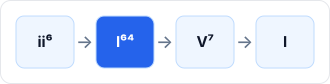
It's a I chord in second inversion sitting just before V in a cadence, and despite the "I" label it actually behaves with dominant function. The cadential six-four (written I⁶⁴) appears right before the V chord — the classic pattern is ii⁶ – I⁶⁴ – V⁷ – I — which is why we previously called it "I/5th."
In what situations do six-four chords appear?
In only four situations in Classical music. A second-inversion chord (fifth in the bass, figure ⁶⁴) is a special case: it appears in only four situations:
- Cadential six-four: before V in a cadence (above).
- Passing six-four: the bass moves stepwise through three notes and the middle chord is a ⁶⁴ — e.g. I – V⁶⁴ – I⁶.
- Pedal six-four: the bass holds three repeated notes and the middle chord is a ⁶⁴ — e.g. I – IV⁶⁴ – I.
- Melodic bass six-four: the bass carries the melody, and when the fifth lands in the bass it becomes a ⁶⁴.
See Triads and Seventh Chords for inversions, and Roman Numerals & Cadences for the cadential context.
Frequently asked questions
Why does the "7" disappear when a seventh chord is inverted? Figured bass only writes the intervals needed to pin down the inversion. Once a seventh chord is inverted, figures like 6/5, 4/3, or 4/2 already identify it, so the "7" is dropped — you write I⁶⁵, not I⁷⁶⁵.
Why does the cadential six-four have dominant function rather than tonic function? Even though it's built on the tonic, it sits right before V and resolves to it, so the ear hears it as part of the dominant harmony — that's why we used to label it "I/5th."
In what situations does a second-inversion chord appear? In Classical music the ⁶⁴ chord shows up in only four: the cadential, passing, pedal, and melodic-bass six-four.