
Voice Leading with Non-Chord Tones
Updated: 2026-07-04Once you have harmonized a progression in four parts, you can decorate it with non-chord tones to make each voice more melodic — instead of just leaping between chord tones.
Key takeaways
- Non-chord tones (passing, neighbor, suspension, and so on) decorate a line so each voice sings more.
- They sit on top of an already-correct voice-leading framework — they don't change the harmony.
- Adding a non-chord tone can accidentally create parallel perfect fifths or octaves.
- Always recheck each pair of voices after adding, especially on strong beats.
- A suspension can disguise a parallel, but it can resurface when the suspension resolves.
How do you add non-chord tones to four parts?
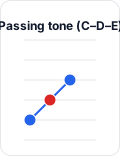
Add passing tones, neighbor tones, or suspensions to any voice to fill in leaps or create motion, all while keeping the harmony intact. Passing tones, neighbor tones, suspensions, and so on can be added to any voice to fill in leaps or create motion. The goal is to make each individual voice sing more naturally while keeping the underlying harmonic framework intact.
How do you avoid parallels created by non-chord tones?
Recheck each pair of voices after every addition, especially on strong beats, since an ornamental note can introduce new parallels. This is the biggest thing to watch for: adding a non-chord tone can accidentally create parallel perfect fifths or parallel octaves between two voices — parallels the original framework did not have.
- Always recheck each pair of voices after adding non-chord tones, especially on strong beats.
- A suspension can delay a motion and thereby disguise a potential parallel — but when it resolves, the parallel can still surface if you are not careful.
Practical rule: non-chord tones are a decorative layer on top of an already-correct voice-leading framework. Get the voice leading right first, then add the ornamental notes — and recheck for parallels after each addition.
See Non-Chord Tones for the types, and Voice Leading Triads for the rule against parallels.
Frequently asked questions
Should you voice-lead first or add non-chord tones first? Get the voice leading right first, then lay the ornaments on top. Non-chord tones are a decorative layer over an already-correct framework, not a way to fix a broken one.
Why do non-chord tones tend to create parallels? When a voice moves through a non-chord tone, it can form a perfect fifth or octave with another voice that the original framework didn't have — usually most exposed on strong beats, which is why you recheck after each addition.
Can a suspension get rid of parallels for good? Not exactly. A suspension delays a motion and can disguise a potential parallel, but when it resolves the parallel can still surface if you aren't careful.