
Acoustic, Digital, and Electronic Pianos
Updated: 2026-07-12After this lesson, you will be able to compare acoustic piano, digital piano, and electronic keyboard by sound mechanism and model-dependent workflow, then produce a requirements sheet that identifies the instrument fit for your actual practice, performance, space, and maintenance plan.
Try now
Finish this sentence: “For the next twelve months, my instrument must let me ___ in ___.” Add the required practice setting, performance role, available space, and whether private headphone practice matters. Do not name a brand or category until the work is defined.
Three mechanisms, three starting questions
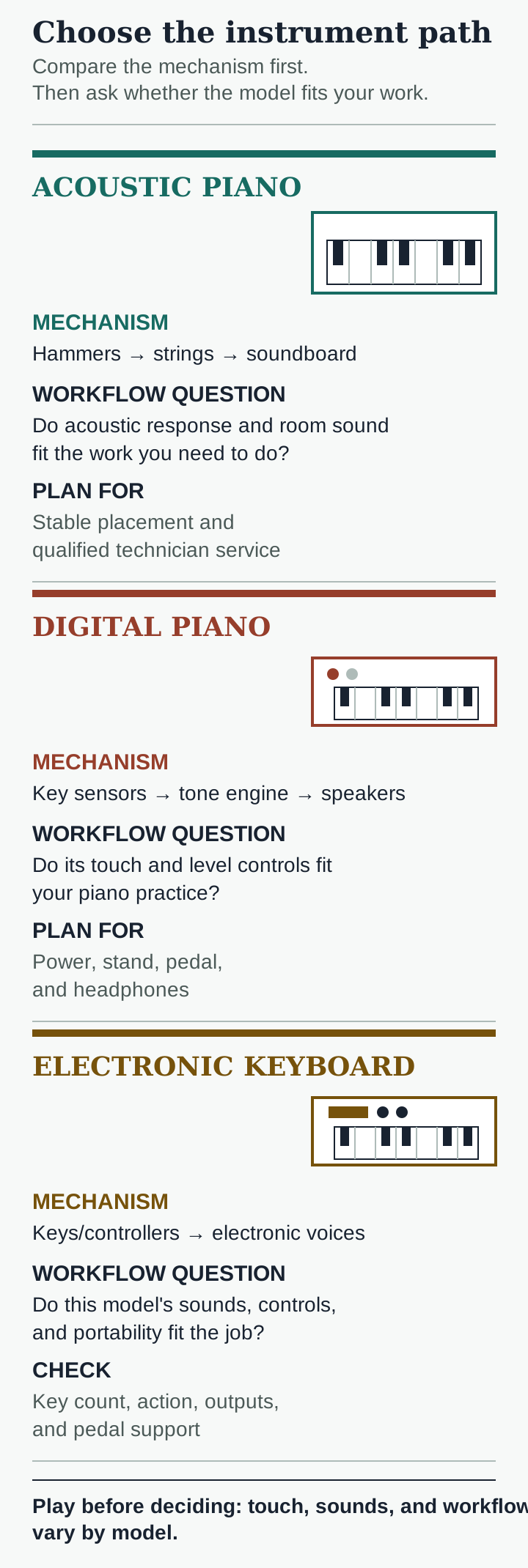
An acoustic piano transfers key movement through an action: hammers strike strings and their vibration reaches the soundboard. Its response and room sound are part of the instrument. Plan for stable placement and service by a qualified technician. It is a strong candidate when acoustic response itself is required, but that does not make it universally best.
A digital piano uses key sensors, an electronic tone generator, and speakers or headphones. Yamaha describes digital pianos as piano-focused instruments and notes that touch response varies by manufacturer and model. Ask whether the tested model’s action, piano sound, level control, pedal behavior, and practice format fit the work. Plan for its specified power source, stable support, pedal, and monitoring needs without assuming every model includes the same features.
An electronic keyboard uses keys or controllers to trigger electronic voices. Key count, action, sounds, controls, outputs, portability, and pedal support vary widely. Ask whether that specific model fits the job. A portable keyboard may suit a rehearsal role while failing a requirement for full piano range or a particular action; another model may do the reverse.
Write requirements before comparing candidates
Separate a requirement from a preference. “Must support the complete range of my recital score” is testable. “Should feel good” needs a procedure: play the same quiet repetition, loud chord, scale, repeated note, and pedal release on each candidate. Write must, verify on model, or not needed now for every row.
| Requirement area | Question to answer | Evidence |
|---|---|---|
| Primary work | Solo repertoire, private practice, band part, travel, or several jobs? | Named weekly task and repertoire range |
| Keyboard | What key count and action does the work require? | Same passage played on the candidate |
| Sound/listening | Is acoustic room sound, speaker level control, or headphone practice required? | Test in the intended setting |
| Pedal/control | Which pedal behavior and controls does the part actually use? | Manual check plus hands-on test |
| Connection | Which documented outputs or inputs must your existing workflow use? | Model manual and equipment list |
| Placement/service | What stable space, support, maintenance, or technician access is needed? | Measured location and service plan |
| Portability | Must one person transport it regularly, or will it remain installed? | Real event and storage requirement |
Price can narrow candidates, but a low price does not compensate for a missing must-have. Likewise, a long feature list has no value when the needed touch, range, or workflow is absent.
Test the model, not the category label
Bring one familiar passage containing soft attacks, loud attacks, repetition, a scale or leap, and pedal changes. Keep the passage and listening position constant. Check whether dynamics respond predictably, repetitions return reliably, the required register exists, and the pedal/control behavior matches the manual. For electronic models, verify only the sounds and controls the job needs instead of judging the largest preset count.
Record observations immediately: works, uncertain, or fails requirement. Category descriptions guide the first shortlist; the model test makes the decision. Hybrid instruments and unusual designs may cross category boundaries, so classify their actual mechanism and workflow rather than forcing the label.
Exercise
Create a one-page requirements sheet with the seven rows above. Add a budget boundary and three candidate slots, but do not rank candidates until every must-have has evidence. Test the same passage and write one result per row. Reject any candidate that fails a must-have. If two remain, choose by the highest-priority verified workflow, not by a claim of universal superiority.
Common mistakes
- Symptom: One category is declared best for every pianist. Correction: Return to the named work, setting, and model evidence.
- Symptom: Digital piano and electronic keyboard are treated as fixed feature lists. Correction: Verify key count, action, sounds, controls, outputs, and pedal support on the model.
- Symptom: A brief loud demo replaces a touch test. Correction: Use the same soft, loud, repeated, moving, and pedaled passage.
- Symptom: Maintenance or support is considered after purchase. Correction: Put placement, service, stand, pedal, power, and monitoring needs on the sheet first.
Practice pack
Prepare
Define the twelve-month job, seven requirement rows, budget boundary, and test passage.
Core drills
Play identical soft, loud, repeated, moving, and pedaled material on each candidate.
Variations
Reorder candidates or hide their prices until the model evidence has been written.
Self-check
Pass when every must-have has a direct test or model-documentation result.
5-minute route
Spend two minutes defining work, two writing must-haves, and one selecting the test passage.
15-minute route
Spend five minutes requirements, six testing one model, and four recording evidence and unknowns.
Frequently asked questions
Is an 88-key weighted instrument always the correct choice? No. It may be a requirement for some piano work, while another role prioritizes different range, controls, or portability. Verify the actual task.
Does a digital piano remove every maintenance need? It does not need acoustic tuning, but the model still has support, placement, power, pedal, and operating requirements defined by its manufacturer.
Can I decide from specifications alone? Specifications screen candidates. Touch, response, sound, and workflow still need a model-specific test when possible.
Ready to continue when
- You can explain the three sound mechanisms without ranking them universally.
- The requirements sheet names a twelve-month use case and seven evidence rows.
- Key count, action, sounds, controls, outputs, and pedal support are model-dependent checks.
- Your choice follows verified must-haves and a practical placement/service plan.