Key Signatures and the Circle of Fifths
Updated: 2026-07-11By the end of this lesson, you will be able to read the three key signatures in the C/G/F range, connect each one to its tonic, and locate it on the complete circle of fifths: C has no sharps or flats, G has F♯, and F has B♭.
Try now
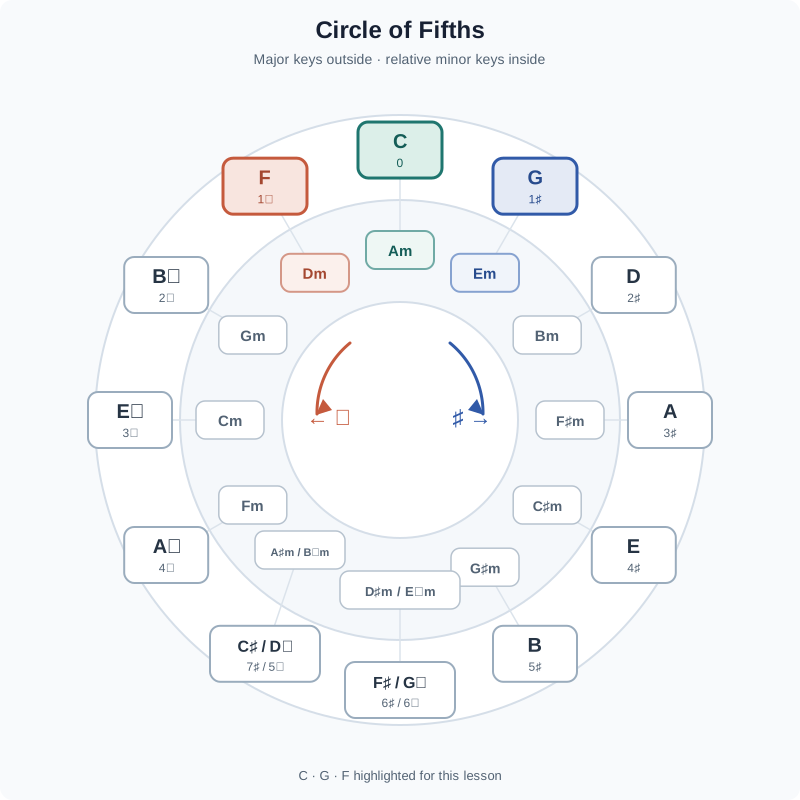
Look only at the highlighted C, G, and F positions. Say, “no sharps or flats is C, one F♯ is G, one B♭ is F.” Then trace both directions from C to verify the order.
A key signature is the default rule
The key signature appears after the clef at the beginning of the staff. It tells you which note names are sharp or flat by default. In this lesson, C major has no sharps or flats, G major has one sharp on F, and F major has one flat on B.
When you see the G key signature, notes named F in the relevant octaves are read as F♯ unless a local natural changes them. The score does not need to repeat a sharp beside every F because the key signature already establishes F♯. This reduces repeated symbols, but the reader must retain that rule across the system.
Tonic and evidence within a phrase
The tonic is the central note that gives a key its name. A key signature narrows the possibilities, but when identifying a short phrase, also consider its opening, ending, and sense of arrival. Each pair below is written so its final note confirms C, G, or F as the tonic.
Do not generalize that the last note always determines the key in every piece. At this level, clearly ending examples help you practice connecting key signature and tonic. Read the signature first, predict the pitch collection, and then check the ending.
The complete circle with a C/G/F window
The outer ring arranges 12 major keys by ascending fifths; the inner ring places each relative minor with the same key signature. Move clockwise from C to G and add F♯. Move counterclockwise from C to F and add B♭. The C–Am, G–Em, and F–Dm pairs are highlighted because they form the present learning window.
The remaining positions show the pattern continuing through enharmonic spellings: F♯/G♭ has 6♯/6♭, while C♯/D♭ has 7♯/5♭. You do not need to memorize them yet. The current goal remains three points you can verify directly with the scales: C D E F G A B; G A B C D E F♯; F G A B♭ C D E.
Exercise
Six key-and-tonic examples
For each measure, record three items: number of accidentals in the signature, altered note name, and predicted tonic. Then play steady quarter notes and listen to the ending. The paired answers are C–C, G–G, and F–F, but count an answer as correct only when you can cite both the signature and the final point of arrival.
On pass 2, cover the captions. Shuffle the three systems and identify each key within five seconds before playing. On pass 3, look only at the local circle and rewrite all three scales with correct spelling. The task connects image, notation, and sound; it is not just memorizing labels on a diagram.
Common mistakes
- Symptom: You see F♯ in G but still wait for a sharp beside each F. Correction: Read the key signature as the default rule for the system.
- Symptom: You reverse G and F on the circle. Correction: From C, clockwise to G adds F♯; counterclockwise to F adds B♭.
- Symptom: You choose the key from the first note alone. Correction: Combine the key signature with the ending and the phrase's point of rest.
Practice pack
1. Prepare
Draw F–C–G as three points; add B♭ at F, no sharps or flats at C, and F♯ at G.
2. Core drills
Identify all six measures and say the key signature and tonic before playing each phrase in steady quarter notes.
3. Variations
One person names a key while the other writes its signature. Practicing alone, shuffle six face-down cards and check after each answer.
4. Self-check
Pass when you identify all six examples and explain each answer from both the signature and the ending tonic.
5. 5-minute route
Spend one minute drawing the local circle, three reading six measures, and one writing the scales.
6. 15-minute route
Spend three minutes on signatures, six reading and playing, three shuffling cards, and three explaining the sharp and flat directions.
Frequently asked questions
Does a key signature replace every accidental? No. A local accidental can temporarily change the default rule within a measure.
Can one key signature belong to both a major and minor key? Yes, but relative minor keys are outside this lesson. Here, clearly ending phrases identify C, G, and F major only.
Must I memorize the whole circle now? No. The figure shows the complete structure so you do not learn an inaccurate or incomplete map, but this lesson assesses only the highlighted C/G/F positions.
Ready to move on when
- You can read C with no sharps or flats, G with F♯, and F with B♭.
- You can explain that a key signature provides the default rule at the start of a staff.
- You can use both directions correctly on the local C/G/F circle.
- You can identify all six examples from their key signatures and ending tonics.