How the Piano Makes Sound and Its Pedals
Updated: 2026-07-10By the end of this lesson, you will be able to describe how acoustic and digital pianos produce sound, distinguish the usual jobs of the left, middle, and right pedals, and run a controlled C-G sustain comparison. Understanding the mechanism tells you what to hear: the start of a note, its decay after the finger leaves, and the point where earlier sound should clear.
Try now
Play one C near the middle of the keyboard, hold it for two seconds, and release it. Repeat with a softer touch. Listen at three moments: when the sound begins, while it rings, and when it stops. Do not use a pedal yet.
Follow two different sound paths
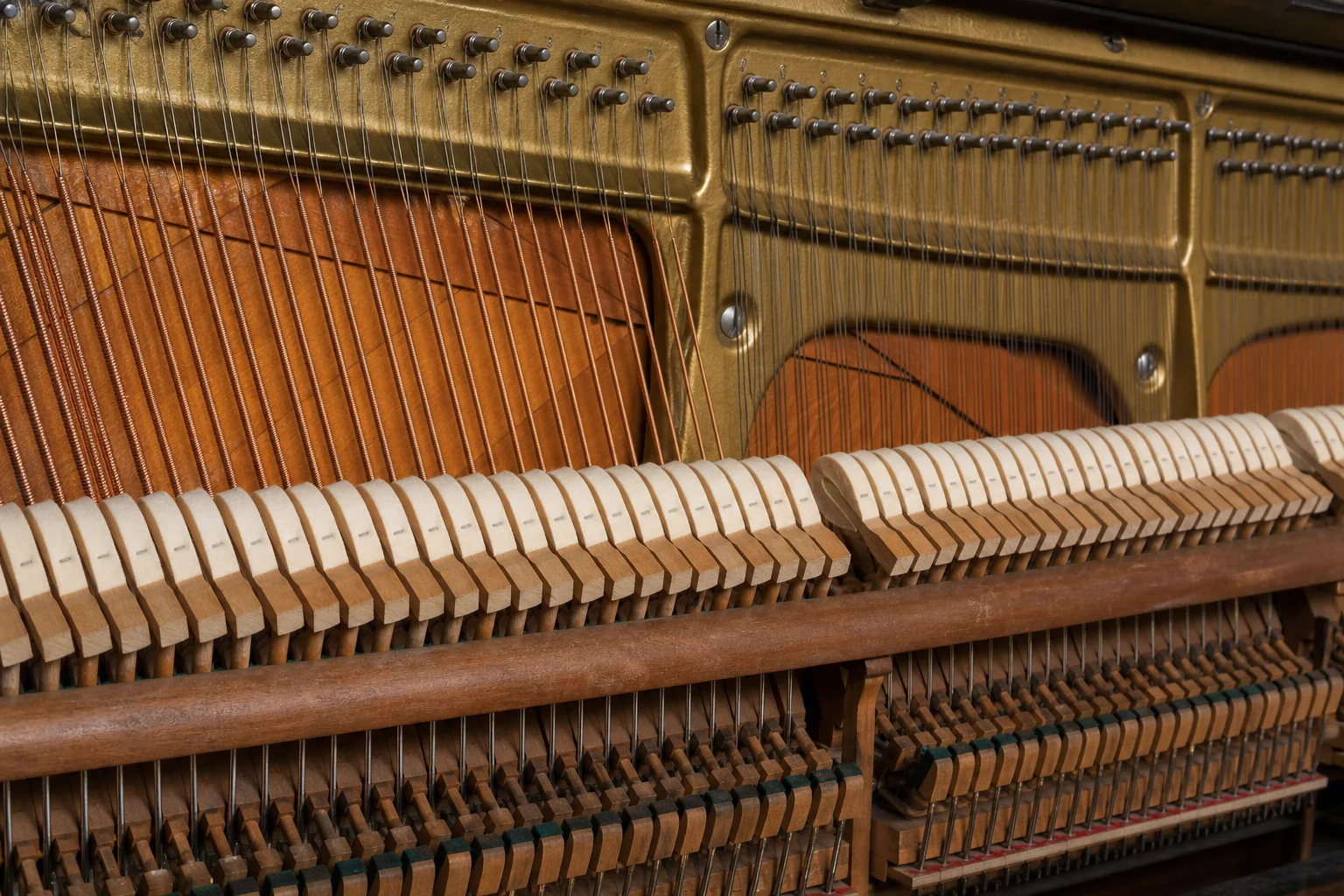
On an acoustic piano, a key starts a lever system called the action. A felt hammer strikes a string and moves away so the string can vibrate. Vibration transfers to the soundboard and air. When you release the key without sustain, a damper returns and stops the string.
On a digital piano, the key does not send a hammer into a sound-producing string. Sensors measure motion or force, a sound engine processes the data, and speakers or headphones deliver it. Some actions use simulated hammers for weight, but they do not strike strings. The gesture can feel related although the sound paths differ.
On touch-sensitive instruments, key speed and force affect the result. Listen rather than watching. A faster attack usually sounds stronger, but pressing after the key reaches the bottom does not keep adding energy. It only adds tension.
Identify the three pedals on your instrument
In a grand-piano layout, the right pedal is the sustain or damper pedal. It lifts the dampers so notes continue after your fingers release them. The middle sostenuto pedal sustains notes selected at the moment you press it, rather than every later note. The left soft or una corda pedal reduces volume and may also alter tone color.
Functions vary. On many uprights, the middle pedal is a practice mute. A digital piano may assign another function or provide only sustain. Read your model's manual instead of assuming from position. This lesson uses only the right pedal.
Move from the ankle and listen for a clean release
Keep your right heel on the floor and the ball of the foot on the pedal. Move from the ankle instead of lifting the thigh. Start with the pedal up. Play a note, press the pedal, release the key, and hear the remaining sound. When you release the pedal, the sound should stop or fall away clearly, depending on the instrument's resonance.
Pedal does not replace holding a note with a finger, and it should not hide an uneven attack. If all notes merge into a cloudy layer, the pedal probably has not cleared between sound groups. Before learning harmonic pedal changes, use the C-G test below only to hear the contrast between dry and sustained sound.
Exercise
Perform a C-G comparison without and with pedal. Count "1-2, 3-4" and play once without pedal. Hear a clear stop when each finger releases at the end of two beats. On the second pass, press sustain just after playing C, lift the finger after beat 2, and hear C continue into G. Release the pedal just after beat 4 and before the next C. Move quickly without stamping.
On a third pass, play the first measure without pedal and the second with pedal. Describe the difference precisely: "the sound lasted longer," "C and G overlapped," or "the sound stopped when the pedal rose." If nothing changes, check the correct pedal jack, digital pedal polarity, and volume before repeating.
Common mistakes
- Symptom: The note stays short although your foot is down. Correction: Play first, press immediately afterward, and verify the pedal connection and power-on polarity.
- Symptom: C and G collect into a muddy layer over several passes. Correction: Release fully after beat 4, hear the clean break, and only then begin again.
- Symptom: Your whole leg rises and your torso rocks. Correction: Keep the heel on the floor, rotate at the ankle, and move the pedal within comfortable reach.
Practice pack
1. Prepare
Identify the right pedal and clear its cable from the bench. Set your heel on the floor and play one C without pedal as the comparison sound.
2. Core drills
Play three C-G passes: no pedal, pedal, then one dry measure followed by one sustained measure. Count all four beats and clear at the planned boundary.
3. Variations
Keep the pulse but play more softly. If the sustain difference remains clear, you are hearing duration rather than confusing it with louder volume.
4. Self-check
You succeed when you describe your instrument's mechanism and create two clearly different listening results. Also confirm that your torso does not rock with each pedal press.
5. 5-minute route
Spend one minute naming the pedals from your manual, three minutes comparing dry and sustained C-G, and one minute practicing a complete release after beat 4.
6. 15-minute route
Play six passes at soft and medium levels, alternating pedal and no pedal. Write one sentence about sustain, one about release, and one foot adjustment.
Frequently asked questions
Is my middle pedal broken if it does not sustain selected notes? Not necessarily. Upright and digital pianos may give the middle pedal a different function. Check the manual for the exact model rather than relying on a grand piano's pedal names.
Why play the note before pressing sustain? This order exposes the note's attack and avoids resonance before it begins. Later, pedal timing will change with the phrase and harmony.
Should I use pedal in every piece? No. Many early exercises are clearer without it because you can hear finger-held duration and each attack. Pedal is a tone-color choice, not a default mode.
Ready to continue when
- You correctly describe the sound path of the acoustic or digital piano you use.
- You identify the right pedal and know that the middle pedal's function can vary.
- The C-G pattern sounds clearly different with and without pedal.
- Your heel stays supported, and the pedal clears completely at the end.