
Planning and Rehearsing a Performance
Updated: 2026-07-12After this lesson, you will be able to work backward from a performance date, schedule repair and complete runs for seven days, and leave with one written rehearsal plan whose daily outputs lead to a playable event rather than vague extra practice.
Try now
Write the event date, the exact program order, and the first sound you must make. Count backward seven calendar days. Beside day 5 write “one complete recorded take; choose exactly two fixes,” beside day 6 write “one event simulation,” and beside day 7 write “landmarks only; stop before fatigue.”
Plan backward from an observable finish
A useful plan begins with the event contract: repertoire and order, expected start procedure, available instrument, page or device setup, transitions, and the final release. “Play better” cannot be scheduled. “Enter, settle, count internally, perform the listed program in order, and close without restarting” can be rehearsed and checked.
Mark the score or chart before assigning minutes. Box section openings, repeats, difficult entries, page turns, pedal changes, and the ending. These become landmarks: places from which you can start without returning to measure 1. Berklee’s practicing materials support goal-aligned routines, score study, road maps, targeted work, recordings, and preparation for an event. The exact seven-day order here is Ledutu’s practical synthesis, so change it when the repertoire demands another sequence.
Separate repair time from performance time
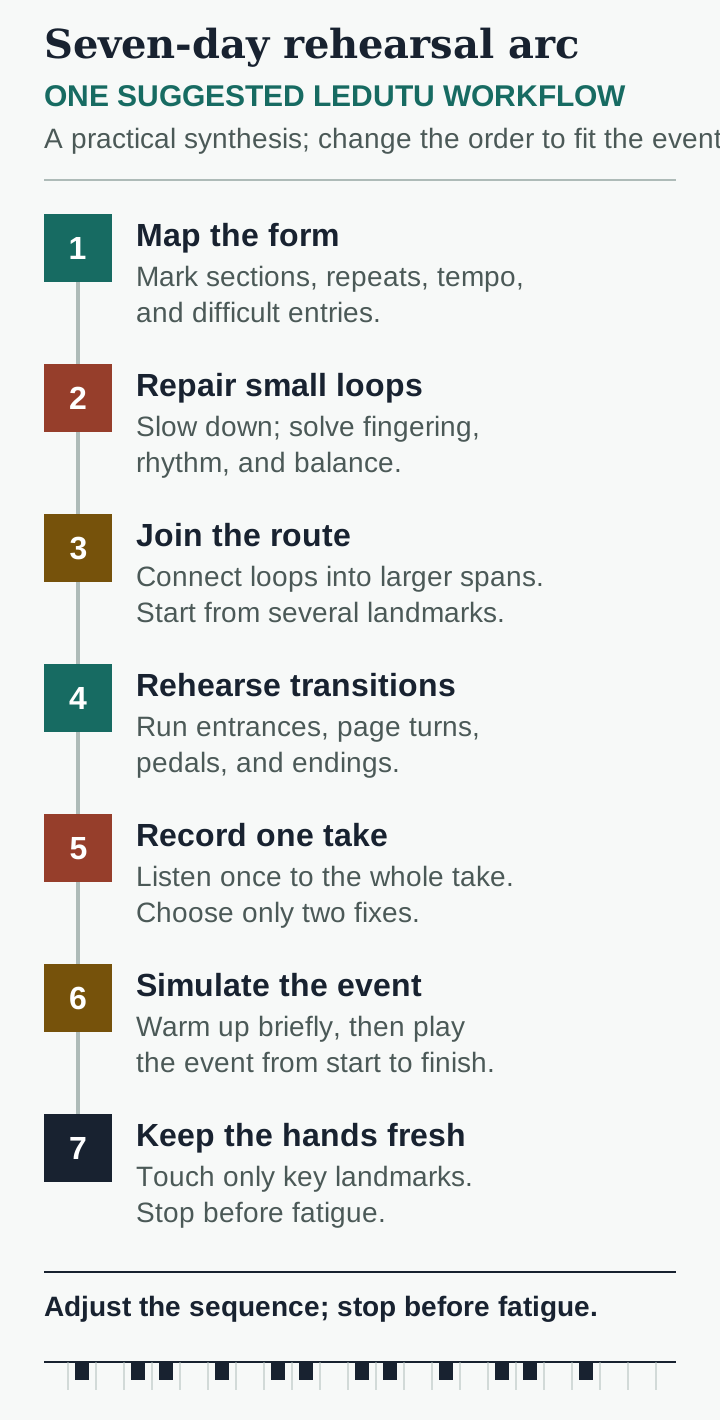
Days 1–4 build reliability. Day 1 maps form and decisions. Day 2 slows small loops to solve fingering, rhythm, or balance. Day 3 joins those loops into longer spans and starts from several landmarks. Day 4 rehearses transitions: entrances, page turns, pedal boundaries, movement between pieces, and endings.
During a repair pass, stop, isolate one cause, and repeat a short unit. During a performance pass, keep the clock and form moving, then log the measure afterward. Mixing the two creates frequent restarts without testing continuity. A repaired loop is not finished until it reconnects to at least one measure before and after it.
Schedule the complete runs
Day 5 contains one uninterrupted recorded run. Listen once from beginning to end, note evidence by measure or transition, and choose exactly two fixes for the remaining repair block. Do not turn the review into a list of every preference.
Day 6 contains a brief warm-up followed by one simulation of the real event: entrance, complete program, planned spaces between pieces, final release, and acknowledgment. Keep the same score, seat, page system, and footwear or clothing constraints when practical. Day 7 is deliberately lighter: touch the opening, selected landmarks, transitions, and ending once; do not add another full run. This schedule tests the whole route twice while protecting the last day from unnecessary volume.
Exercise
Complete this seven-day deliverable and keep it on one page:
| Day | Rehearsal job | Evidence to retain |
|---|---|---|
| 1 | Map form, repeats, tempo, and difficult entries | Marked roadmap and program order |
| 2 | Repair short loops slowly | Problem, cause, and chosen solution |
| 3 | Join loops; start at several landmarks | Successful starting-point list |
| 4 | Rehearse entrances, page turns, pedal, transitions, endings | Transition checklist |
| 5 | Record one complete take; listen once | Recording plus exactly two fixes |
| 6 | Warm up briefly; simulate the complete event once | Completed simulation and short log |
| 7 | Touch only openings, landmarks, transitions, and ending | Final cue list; stop before fatigue |
The finished deliverable is the dated table, marked roadmap, Day 5 recording with two fixes, and Day 6 simulation log. If the event is more than seven days away, repeat the repair-and-join cycle earlier; keep this final arc nearest the event.
Common mistakes
- Symptom: Every day is another beginning-to-end run. Correction: Reserve days 2–4 for isolated repair, reconnection, and transitions.
- Symptom: A loop works alone but fails in context. Correction: Add one measure before and after, then enter from a landmark.
- Symptom: Day 5 review produces ten urgent changes. Correction: Listen once and select exactly two fixes with measure evidence.
- Symptom: Day 7 becomes the longest session. Correction: Touch only planned cues and stop before fatigue.
Practice pack
Prepare
Write the event contract, program order, seven dates, and score landmarks.
Core drills
Alternate short repair loops with joined spans; rehearse every program transition and ending.
Variations
Start from each landmark in shuffled order, then restore the published program order.
Self-check
Pass when every day has evidence and both complete runs finish without a restart.
5-minute route
Spend one minute mapping, two repairing one loop, one reconnecting, and one updating the sheet.
15-minute route
Spend three minutes mapping, six repairing, three joining, two on transitions, and one logging evidence.
Frequently asked questions
Must every program use this exact order of days? No. It is an editorial workflow. Preserve the jobs and evidence, but move a repair or simulation when the event requires it.
How many complete runs should I do in the final three days? This plan schedules one recorded run on day 5 and one simulation on day 6. Day 7 is a light cue check, not a third run.
What if a piece is still unstable on day 6? Define a simpler, playable event decision before the simulation, such as a slower controlled tempo or an authorized shorter program. Do not improvise the decision after starting.
Ready to continue when
- Your one-page plan works backward from a dated event and exact program order.
- The roadmap identifies form, starting landmarks, transitions, and the closing release.
- Day 5 produces one full recording and exactly two evidence-based fixes.
- Day 6 produces one event simulation, while day 7 remains a light landmark check.