
Influential Pianists Across Styles
Updated: 2026-07-12After this lesson, you will be able to use a selective, non-exhaustive listening map, document evidence in your own words from authoritative institutional or public-archive sources, and transfer one broad craft variable without copying melody, lyrics, transcription, recording, or an artist signature.
Try now
Choose one stop and listen for two minutes through an institutional or public-archive source available to you. Write one timestamp, one audible observation, and one question. Do not write down the notes, reproduce lyrics, or imitate a recognizable phrase.
Seven doors, not a canon
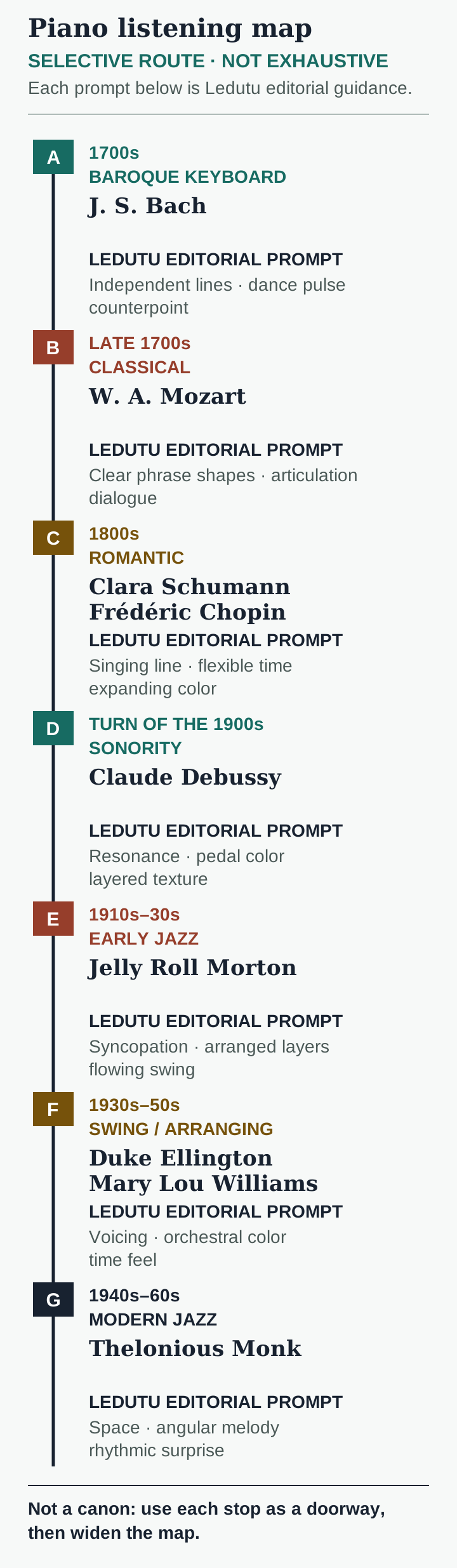
The map moves through seven editorial doors. Its dates and placements are broad historical orientation supported by The Met, Library of Congress, and Smithsonian sources. The “hear” phrases are Ledutu prompts: they help focus attention but do not claim that one artist owns a trait or that the trait summarizes an entire career.
| Door | Names on the selective map | Ledutu editorial prompt |
|---|---|---|
| Baroque keyboard, 1700s | J. S. Bach | Independent lines, dance pulse, counterpoint |
| Classical, late 1700s | W. A. Mozart | Clear phrase shapes, articulation, dialogue |
| Romantic, 1800s | Clara Schumann; Frédéric Chopin | Singing line, flexible time, expanding color |
| Sonority, turn of the 1900s | Claude Debussy | Resonance, pedal color, layered texture |
| Early jazz, 1910s–30s | Jelly Roll Morton | Syncopation, arranged layers, flowing swing |
| Swing/arranging, 1930s–50s | Duke Ellington; Mary Lou Williams | Voicing, orchestral color, time feel |
| Modern jazz, 1940s–60s | Thelonious Monk | Space, angular melody, rhythmic surprise |
The Library of Congress documents Mozart’s Classical-era life and Clara Schumann’s work as a virtuoso pianist and composer. Smithsonian sources place Morton in the ragtime-to-jazz transition, describe Williams across changing jazz eras as pianist/composer/arranger, and discuss Ellington’s orchestral color and Monk’s spare, angular language. These facts support orientation; the listening prompts remain editorial.
Use institutional doorways and source boundaries
Begin with The Met’s keyboard-instrument publication, the Library of Congress Mozart guide, its Clara Schumann collection article, the Smithsonian anthology notes, the Smithsonian Mary Lou Williams archive profile, and the Smithsonian jazz history. These are institutional context or archive doorways, not commercial tune links.
When audio is available through an institution or public archive, record the institution, item title, access date, and timestamp. Describe attack, register, density, pulse, balance, release, or form in your own words. Do not copy lyrics, notated passages, transcriptions, album art, or recordings into the journal. This lesson makes no usage-rights or clearance claim.
Transfer variables without copying identity
A useful journal moves from evidence to a neutral experiment. “At 0:42, the texture thins before the return” can become “leave one measure of reduced density before my own final phrase.” It should not become a copied melody, voicing sequence, riff, solo, or signature timing pattern. Use several doors over time so one reference does not become a cloning target.
Expand the map after the exercise. Add one pianist from a region, community, period, or keyboard tradition not represented here, but only after finding an institutional biography or public-archive record. Label your new listening focus as your own editorial prompt rather than a definitive style claim.
Exercise
Complete three journal entries from three different doors. Each entry contains institutional/public-archive URL, access date, two-minute listening window, timestamp, audible evidence, the relevant editorial prompt, and one four-measure experiment using your own notes or an existing Ledutu original. Change one broad variable only. Include no copied lyric, transcription, commercial link, or artist image. Finish by proposing one sourced eighth door and stating why it broadens the map.
Common mistakes
- Symptom: The seven stops are presented as the complete history. Correction: Keep “selective, not exhaustive” visible and add a sourced eighth door.
- Symptom: A prompt is treated as an exclusive artist definition. Correction: Label it Ledutu editorial guidance and cite audible evidence.
- Symptom: The journal copies notes or a recognizable phrase. Correction: Describe a broad variable, then use original material.
- Symptom: A commercial tune page becomes the source. Correction: Use an institution or public archive and record its item metadata.
Practice pack
Prepare
Choose three doors, open only institutional/public-archive sources, and create journal fields.
Core drills
Listen for two minutes, timestamp one event, describe evidence, and name one neutral variable.
Variations
Compare the same variable across two doors without ranking artists or copying material.
Self-check
Pass when three entries are sourced, evidence-based, original, and explicitly editorial.
5-minute route
Spend two minutes listening, one timestamping, one describing, and one planning an experiment.
15-minute route
Spend six minutes across three excerpts, six writing evidence, and three designing one original test.
Frequently asked questions
Why are these pianists grouped together? The groups provide broad chronological doors and contrasting listening variables, not a claim of equal style or a complete lineage.
May I transcribe a phrase into the journal? Not in this lesson. Use timestamps and your own descriptive language; do not copy lyrics or transcription.
Where should I listen? Use authoritative institutional or public-archive access. No commercial tune pages are linked here.
Ready to continue when
- You state that the map is selective, non-exhaustive, and editorial.
- Three entries use only institutional/public-archive links and include timestamps and evidence.
- Your experiment transfers a broad variable without copying notes, lyrics, recordings, or identity.
- A sourced eighth door widens the map beyond its current geographic and stylistic limits.